

 Dementia Support Line
Research
Studying why some people are more vulnerable to Alzheimer’s disease
Researcher Austeja Dapkute is trying to understand why the symptoms of Alzheimer’s disease develop at different speeds.
Austeja Dapkute has always been interested in understanding how diseases develop and affect the body.
After studying in Lithuania and working around the world, Austėja, a neurologist, is now an Alzheimer’s Society Clinical Training Fellow at the University of Oxford.
Her research is all about trying to understand why some people are more vulnerable to Alzheimer’s disease than others.
Her motivation to work in dementia research is very personal.
‘My grandmother developed dementia and seeing how it affected her and our family was deeply painful. Even as a specialist, I felt there was very little I could do.
‘That experience made me want to contribute to research that could lead to better understanding and treatments.’
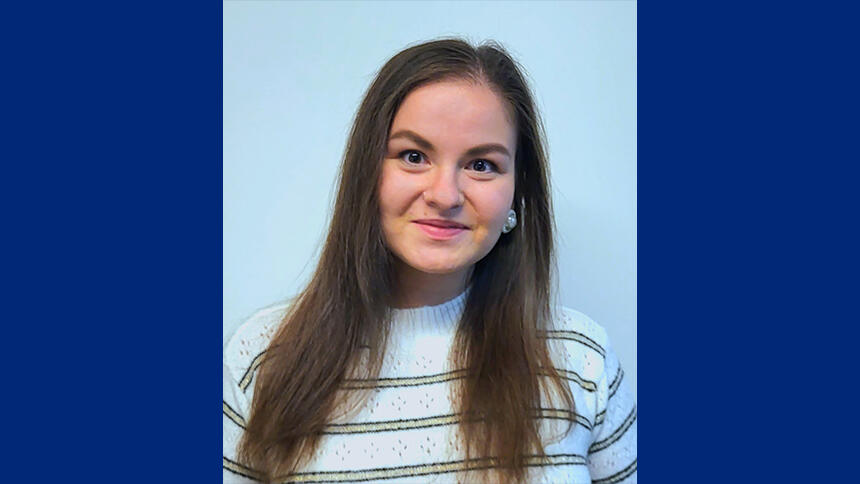
Austeja Dapkute
Learning what protects brain cells
By studying the brain’s immune cells, which are known to be very important in Alzheimer’s, Austeja is looking at why people develop symptoms at different speeds.
‘In the lab, I study cells with the same genetic background as patients and expose them to conditions similar to Alzheimer’s disease.’
Austėja then compares how these cells respond and if this correlates with information from brain scans, blood markers and memory tests.
The aim is to understand why some people seem to be more resilient, even when they are at higher genetic risk.
If we can learn what protects them, it may help us find new ways to slow down or prevent dementia in others in the future.

Why there’s hope in dementia research
Austeja’s days are a mix of laboratory work and computer-based analysis. Her detailed work requires great patience and focus.
But she also thrives on teamwork and the collective energy around dementia research.
‘I am surrounded by people at different stages of their research careers. I also work with collaborators who bring different expertise to the project.
From my personal experience, having a strong community around you makes a real difference.
Austeja says that support from Alzheimer’s Society has been valuable in many ways.
For example, it’s helped shape her research and make it more relevant to people affected by dementia. Her fellowship has also opened up new academic opportunities and she’s now studying for a doctorate in clinical neurosciences.
‘This gives me access to excellent collaborations and research facilities. It also supports me in maintaining my clinical skills, which is very important to me.’
While acknowledging the difficulties, Austeja says she wants to share her positivity about dementia research.
I want to emphasise that research is moving forward all the time. We are learning more about dementia every day.
‘So while it is incredibly challenging, there is real reason to stay hopeful that, with continued support for research, we will find better ways to treat and prevent dementia.’
Your donation funds research
Your donation helps us to fund research into all forms of dementia, from prevention to breakthrough drug treatments.