

 Dementia Support Line
Norfolk and Waveney STP dementia pathway development
Multi-channel involvement to inform integrated care pathway.
The purpose:
To develop a new dementia pathway across the area served by the Norfolk and Waveney STP (a multi-agency Sustainability and Transformation Partnership covering a population of approximately 1 million people) by the end of March 2019.
This work was carried out collaboratively across the whole system, with people living with dementia and their carers placed at the centre of the process.
The aim of the activities with people affected by dementia was to learn from their experiences in order to:
- identify how integrated health and care support for dementia could be provided across the entire pathway
- develop detailed recommendations and ideas for implementation.
Preparation
The engagement events were commissioned by the STP, which is Chaired by Dr Liz Waddy, GP, and includes members from Alzheimer's Society and other organisations.
What happened
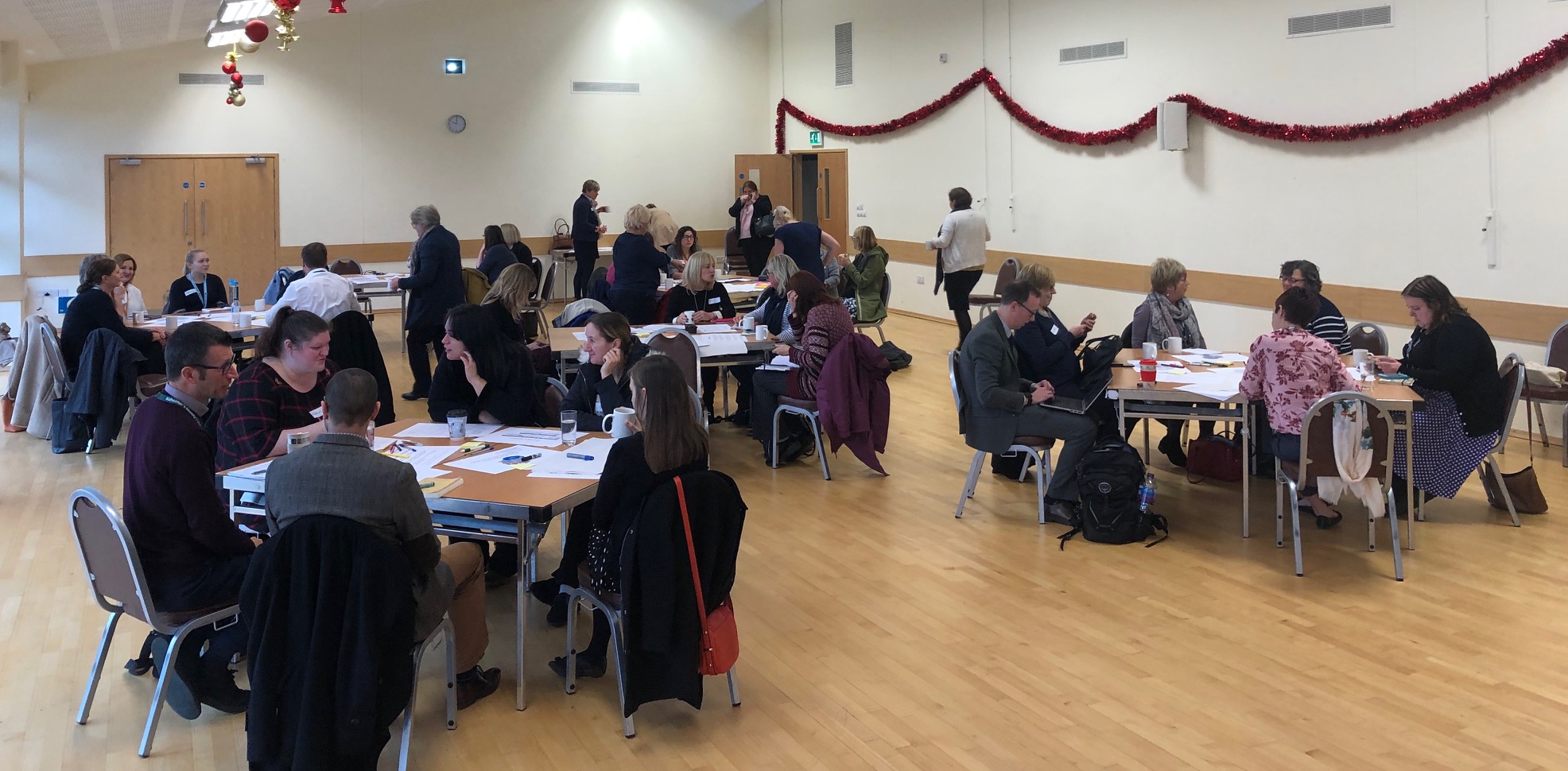
The STP invited people affected by dementia to six events, within which around 36 tabletop focus groups took place. There were 112 attendees in total, including 10 people living with dementia, 23 carers and 93 professionals. Participants worked in mixed groups at each table.
The multi-agency team organising the events took each stage of the NHS Dementia Well Pathway and used short, open questions to facilitate conversations in which everyone had the opportunity to say what “good” meant to them.
A presentation guided participants through the day step by step, enabling them to consider each part of the pathway in turn.
The team also used the Dementia Statements; for each pillar of the Well Pathway, they referenced a corresponding “We” statement.
The team had an engagement pack sent out to people unable to attend the events. They made links to the Dementia Statements. The pack included a simple answer sheet in Word format so that it could be viewed and completed easily, including with assistive technologies, or printed out and completed on paper. About 20 people chose to do this, including people affected by dementia.
The team held a focus group with 15 carers at a big dementia café in Wymondham.
The team had five or six detailed structured conversations with professionals.
The results
Through involving people affected by dementia in the conversations, the STP team gained new insights into gaps in provision. One significant finding was a lack of support for carers when they become bereaved or when the person with dementia they have been caring for moves into a care home.
In March 2019, the STP team sent an update to participants to share what had been learned through the engagement activity, outline the next steps and invite people to indicate if they would like to remain involved.
Key project learnings
- Consider timing.
Think about how long it may take people to get ready and travel. What public transport is available? Events starting at 9:30am may be too early for some participants. - Design your approach collaboratively.
Work with organisations such as Alzheimer's Society when planning involvement activities. - Adapt involvement approaches to be dementia-friendly.
Avoid jargon, keep questions simple and be flexible. This allows conversations to follow what matters most to people affected by dementia. - Explain any necessary terminology.
Consider carefully any jargon that needs explanation. The team found that words such as “pathway” and “map” were challenging, as their everyday meanings differ from how they are used in health and care planning. - Think carefully about facilitators.
You may need additional facilitators to help people living with dementia participate in mixed-group conversations.
With the support of the Alzheimer's Society, the STP was able to provide a roving facilitator in addition to table facilitators. The roving facilitator offered extra support to help people living with dementia participate effectively in discussions. - Provide a dementia-friendly welcome.
Building rapport at the start of the event is important. Making sure people are welcomed warmly and have tea or coffee on arrival can help create a comfortable environment before discussions about personal experiences begin. - Consider the emotional impact of sensitive topics.
Topics such as “Dying Well” can be emotionally challenging. Ensure that people can choose whether or not to take part in these conversations.
“Dying Well” was the final topic discussed at the events. Some feedback suggested it was not the best topic to end the day with. However, the team introduced it early in the programme and were clear from the outset that the whole pathway would be discussed. This allowed participants to decide whether they wished to take part in those conversations.
Support was also made available during the day for anyone who needed it.
Key contacts
William Snagge, NHS North Norfolk CCG
Dr Liz Waddy, GP
Debbie Foster, Alzheimer's Society, Norfolk and Suffolk