

 Dementia Support Line
Real stories
Walking the Camino to fundraise for dementia
Kevin Osbon and his wife Victoria, in Nottinghamshire, walked the Camino Way to celebrate loved ones and raise funds for Alzheimer’s Society.
My wife Victoria and I had been on the verge of booking the trip of a lifetime to New Zealand. But in the space of just three devastating months, everything changed.
My father, who had been unwell for some time, passed away.
Then, in quick succession, we lost my warm and vibrant Aunt Carmel, one of my closest friends Derek, who supported me through some of the hardest moments in my life, and our neighbour Margaret, an adopted grandmother to our five children.
All three had been diagnosed with dementia.
My relationship with my father had always been complicated, although we’d tried to reconnect. In different ways, Carmel, Derek and Margaret filled the gap left and they were all incredibly important to me.
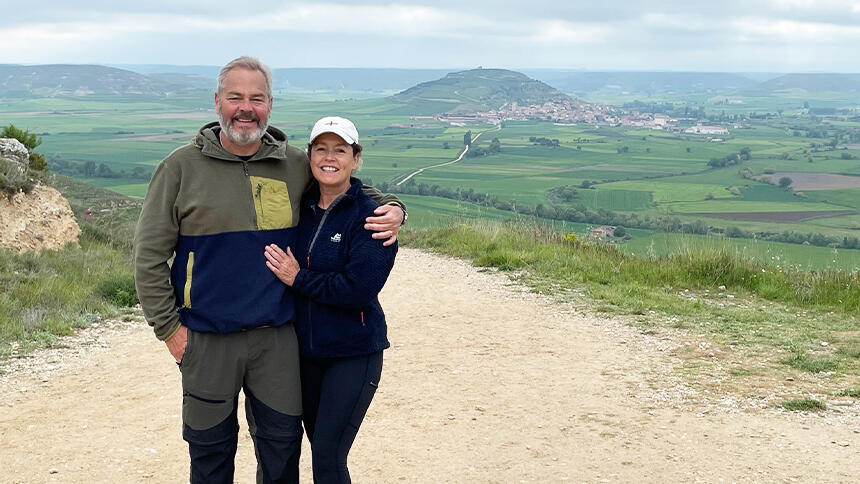
Kevin and Victoria
Planning our dementia fundraising
In the quiet that followed, Victoria and I decided we wanted to do something meaningful to honour Carmel, Derek and Margaret, and that’s when the idea of taking on the Camino Frances was born.
Fundraising has always been important to me.
Over the past 20 years, I’ve taken on lots of different challenges across the world, including climbing Kilimanjaro and Mont Blanc and trekking to Everest Base Camp and crossing the Sahara Desert.
But this time, we wanted something different, something deeply personal.
Walking helped us process our grief
Camino Frances is the most popular pilgrim route of the Camino de Santiago, which translates as the Way of Saint James. It goes from a French village close to the Spanish border to the Cathedral of Santiago de Compostela in northwest Spain.
Preparing for the trek was intense.
We knew we’d be walking up to 15 miles a day for several weeks, so training became part of daily life. Not a day went by without us doing at least 10,000 steps. We also did longer walks, including the Wainwright Coast to Coast.
The journey itself was physically and emotionally demanding.
There were days when it felt impossible to keep going, but somehow we always did.
Along the way, we found incredible camaraderie – people from all over the world supporting each other.
It gave us space to process our grief. At first, the physical exhaustion seemed to match the emotional weight we carried. But over time, things began to shift. Reflection turned into acceptance and pain into something lighter.
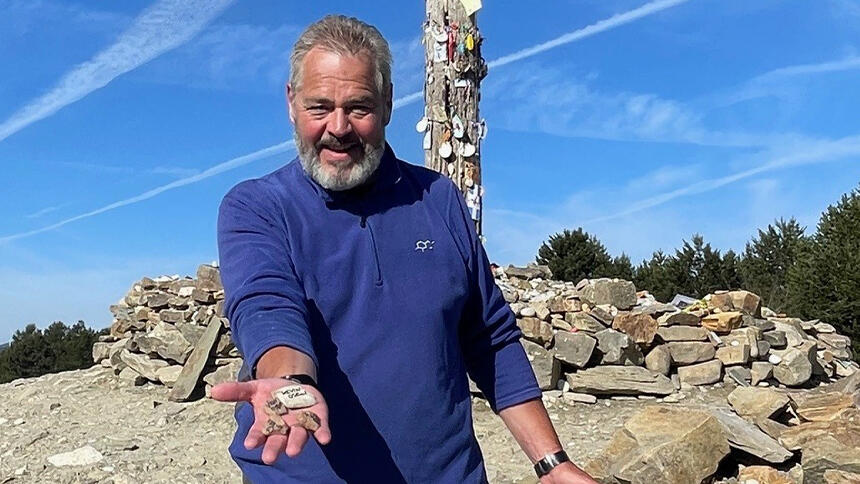
One of the most powerful moments was at the Cruz de Ferro, the Iron Cross, in the mountains of northern Spain. There, I left four stones to represent each person we’d lost. I carried them from the start so leaving them felt symbolic – a way of letting go of some of the grief and anger.
How it felt to finish our dementia fundraiser
It took 35 days to walk the 565-mile route, that’s over 1.2 million steps between us. I lost 14kg in weight!
By the time we reached Santiago de Compostela, we felt changed.
Finishing was emotional but also quietly reflective.
We felt more at peace, with a renewed appreciation for life and the people in it. We celebrated with fellow pilgrims, many of whom have become lifelong friends, but also took time to sit alone and take it all in.
We were thrilled to raise over £6,000 for Alzheimer’s Society.
If I have one piece of advice to other people about taking on a fundraising challenge, it’s this: do something that pushes you but also benefits you and others. Do something that makes a difference on more than one level.
I’ve continued fundraising, including taking part in a Strictly-style dance event that raised £5,500 for children with neuroblastoma.
For now, I’m recovering from shoulder surgery and taking a short break from challenges, but I know I’ll be back!
Get a free fundraising guide
Inspired by Kevin and Victoria? Discover everything you need to organise your own fundraising activity.