

 Dementia Support Line
Real stories
Guilt is everywhere for carers of people with dementia
Pat Sikes is an Alzheimer's Society researcher whose husband lives with dementia. She explains the power of speaking out instead of stewing in guilt.
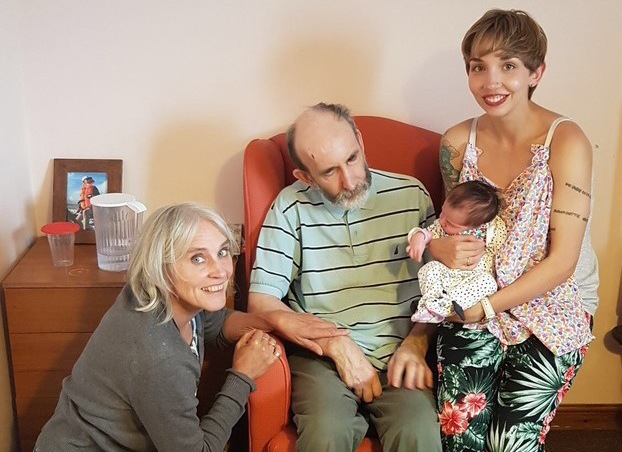
Pat (left), posing with husband David, daughter Robyn and newborn Poppy Joan
In many families where someone develops dementia there can be quite a time lag – in some cases, years - between the onset of the condition and diagnosis. Behaviour which is out of character, particularly when it’s unpleasant, can be very hard to live with and to respond to.
If, for example, a person who was previously gentle and loving becomes distant, disruptive, aggressive or abusive, it’s natural to give like for like and be nasty back.
This can leave us feeling very guilty once we understand the cause.
Of course dementia also happens in families where relationships were not great to start with, but the guilt can still be there. Sometimes with knobs on.

Feelings of guilt for carers
A quick look at posts on the Talking Point forum shows how guilty many carers and relatives can feel.
Guilt is everywhere.
There is guilt about how we behaved towards them pre- and post- diagnosis; guilt about decisions taken – especially around deciding on residential care; guilt about educational and career choices which take people away; guilt about enjoying life events which the person with dementia isn’t aware of, and so on.
Young people who took part in the Alzheimer’s Society funded project that Dr Mel Hall and I undertook – 'The problems and effects of children and young people who have a parent with dementia' - often spoke about their guilt and how bad it made them feel. I know about this on a personal level too.
Pat's experience

The signs of Pat's husband's dementia first appeared 15 years ago
My husband, David, has vascular dementia and posterior cortical atrophy. The signs began to show around 15 years ago when he was 55 and our kids were 13 and 15.
Those 15 years have been rough – made rougher by David’s complete denial that anything was wrong.
Add to that his avowal that we were all ******* idiots, his disengagement, physical aggression and—until he stopped communicating verbally—some extremely hurtful and vicious comments.
For instance, when our daughter was in the middle of university applications he told her ‘they don’t take people like you at Cambridge’. (They did!)
For the last 3 and a half years David has lived in care because we were unable to keep him safe at home. He is very limited in what he can do now but the guilt – for our retaliations, for our care choices, for our feelings - continues. As does the sadness that he hasn’t been able to share in graduations, weddings, the birth of his first grandchild.
Sharing our stories
I wrote this piece because once again a guilt wave (guilt tsunami more like) has overwhelmed me. This time it's down to a change in caring arrangements.
I know that it's an unproductive feeling. I know that I can only continue to do the best that I can by David – and I know that I work very hard to do that best. I also know that others feel like me.
Let’s not compound our feelings of guilt by keeping them as guilty secrets. Sharing our stories with people who know what it’s like is so important, helping us to move forward where stewing in guilt will not.
Next steps
- Read more personal stories from people affected by dementia
- Want to share your story with us? Contact the blog team or leave a comment below