

 Dementia Support Line
Research highlight
What is Neprilysin and how could it help in treating Alzheimer’s disease?
Joanna Zukowska describes her Alzheimer's Society funded project investigating how to clear toxic amyloid protein from the brain.
Alzheimer's Society has been following the research of Joanna Zukowska, supervised by Professor K. Ravi Acharya and Dr Vasanta Subramanian. Here, she explains her findings on Neprilysin and its effect on amyloid-beta.
Why is this research important?
In Alzheimer’s disease, a small toxic molecule called amyloid-beta builds up in the brain, causing damage to the cells. In healthy individuals, amyloid-beta is quickly cleared from the brain by molecules called enzymes.
Enzymes work by chewing up amyloid-beta before it has the chance to build up and cause any harm. However, as we age, the production of these enzymes is reduced, causing the amount of toxic amyloid-beta to increase.
One of the enzymes very closely linked to amyloid-beta clearance is called Neprilysin.
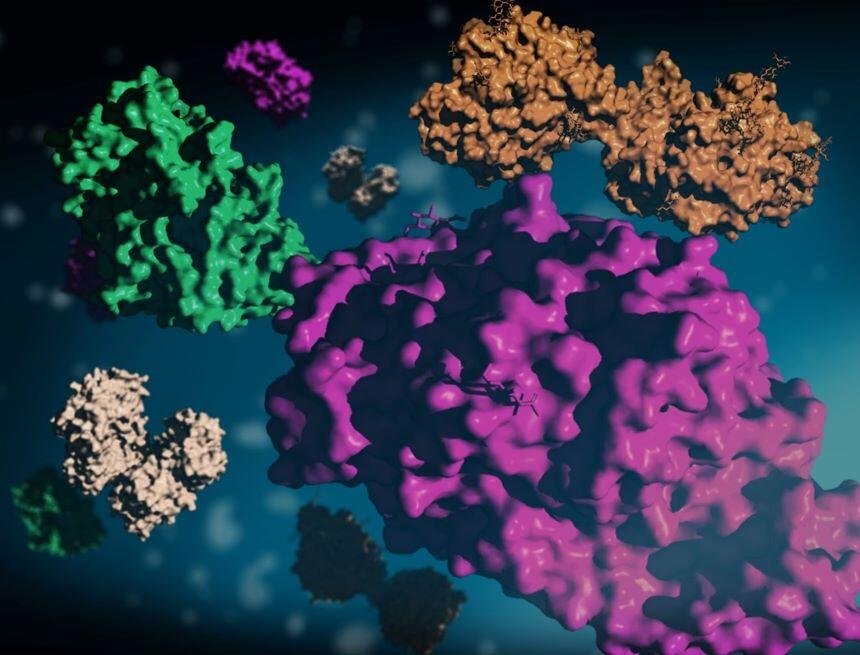
Figure showing Neprilysin (purple) and other enzymes which help clear amyloid-beta in the brain. Graphics designer and picture credit: Maciej Żukowski.
What do we know about Neprilysin?
Neprilysin naturally occurs in the human body. It can be found in the brain, kidneys, lungs, heart and blood vessels. Because of how widespread Neprilysin is, it can target and clear many small molecules – known as substrates – in our bodies.
Enzymes like Neprilysin can be modified to become better or worse at their job of clearing their substrates – this is known as enzyme engineering.
However, because Neprilysin is built to tackle such a range of substrates, the task of engineering its function becomes harder. For example, Neprilysin’s function within the heart is to help with blood pressure regulation, improving Neprilysin’s function at clearing its substrates within the heart could result in heart failure.
It’s therefore very important to engineer a form of Neprilysin which would be specifically better at clearing amyloid-beta in the brain, without affecting the clearance of any of the other substrates in other parts of the body.
Research on Neprilysin as an Alzheimer’s treatment
In Prof Ravi Acharya’s lab, six modified versions of Neprilysin have been created. These modified versions are called ‘mutants’.
Five of them were created to be better at clearing amyloid-beta. The sixth mutant was designed to be inactive, with Neprilysin’s activity completely switched off.
The inactive version is useful for our studies, particularly for a technique called X-ray crystallography which allows scientists to take detailed pictures of molecules such as Neprilysin or amyloid-beta. By looking at these molecules together, we can see how they interact. Understanding these interactions helps us learn how Neprilysin works and how we might modify it to improve its function in the future.
As part of the work funded by Alzheimer’s Society, the five active Neprilysin mutants were tested to see how well they can break down different molecules, compared to standard Neprilysin. We observed that each mutant behaved differently, showing that the changes we made in the lab had a real effect.
In the future, we will test these mutants on more specific targets, such as amyloid-beta. We will look at how quickly and effectively they break down the molecule, and whether they can be used as a treatment for Alzheimer’s disease in the future.
Enzyme therapy
Using enzymes such as Neprilysin as a treatment option is known as 'enzyme therapy'. Enzyme therapies have already been used to successfully treat other diseases such as Fabry disease, Pompe’s disease, Gaucher disease, and leukaemia.
Unlike some other treatments, enzyme therapy often causes less side effects. This is because these enzymes are naturally found in the human body, so our immune systems are less likely to react negatively to them. For Alzheimer’s disease, enzyme therapy could be a promising alternative – especially for people who don’t respond well to current treatments, or who might need a different treatment option due to other health reasons.
Our current research
We are the only UK dementia charity that funds the full spectrum of dementia research, from basic biomedical to care research.