Dementia Support Line
Calling for a cancer-style revolution for dementia care
Dementia diagnosis, treatment, care and support needs to make the same progress that transformed cancer care.
Dementia care stuck in the 20th century
We are calling for a cancer-style revolution for dementia care that is ‘stuck in the 20th century’.
Progress on cancer over 50 years gives policymakers the blueprint for tackling dementia, say The King’s Fund and Alzheimer's Society, but we have to get there faster.
An outline of the steps to make progress with dementia
Survival rates for cancer have almost doubled since the early 1970s, when it was broadly considered a death sentence. We are working with independent think-tank The King’s Fund and have today set out the steps that the Government, NHS and social care leaders must take if dementia diagnosis, treatment, care and support is to make the same progress seen for cancer.
Former National Cancer Director, Professor Sir Mike Richards, has also backed the work, saying:
Dementia deserves the same ambition that has transformed cancer care.
Transforming dementia diagnosis, treatment, care and support
The King’s Fund and Alzheimer’s Society cite the key developments that have driven the transformation around cancer, including leadership, public attitudes, clear targets for diagnosis and treatment, and a commitment to improving the quality of data.
We conclude that cancer provides a blueprint for dementia but, with UK prevalence set to rise from 1 million now to 1.4 million by 2040, and the cost to the UK economy predicted to double in that time to £90 billion a year, progress needs to be much faster.
A chasm between dementia and cancer care
Our survey of 1,000 people caring for someone with dementia exposed the chasm between people’s experiences of dementia care and cancer care.
Around a quarter of respondents were able to make a direct comparison between diagnosis, treatment and support for both dementia and cancer. Over half (51%) said their experience of dementia care was worse and only one in ten (11%) said it was better.
Ambition to change dementia care
Sarah Woolnough, Chief Executive of The King’s Fund, said:
'There was a time when cancer was thought of as a death sentence, frequently referred to as the 'Big C', such was the fear around a diagnosis. Whilst still a major killer claiming far too many lives, many people are living well and after cancer and there has been a remarkable transformation in cancer outcomes in a relatively short space of time.'
'The same cannot be said for dementia care, with approaches to treatment still stuck in the 20th century. There is ambition that this might be about to change, with recent major scientific advancements giving hope that dementia treatment on the cusp of a cancer-style revolution in care.'
'We will only be able to fulfil this potential if the health and care system is ready to diagnose dementia swiftly and roll out new innovations at scale.'
'That is currently far from the case, and we believe that lessons can be learnt from the progress made in cancer.'
The potential for wholesale change is within reach; policymakers now need to follow these steps in order to grasp it.
A need for a clear dementia pathway
Michelle Dyson, CEO of Alzheimer’s Society, said:
'If you have cancer, it is treated urgently, you get a specific diagnosis, and there is a clear pathway that takes you through your care and treatment.
With dementia, it can be years before you get a diagnosis and, all too often, people are sent home with a leaflet and little else.
'Both are horrendous conditions, and there is still much to do for cancer care, but people’s experiences are worlds apart.'
'I know first-hand, as a former Director General in the Department of Health and Social Care, what happens when something is made a priority, with proper targets, investment, leadership and accountability. We desperately need this for dementia.'
'Urgency is critical. Dementia is the UK’s biggest killer and we cannot afford for this to take 50 years. Government must make dementia a priority and learn what it can from cancer to create a future where dementia no longer devastates lives.'
Lessons that can be learned for dementia
The report has been published ahead of a panel discussion at Alzheimer’s Society’s Annual Conference today.
Sarah Woolnough, CEO of The King’s Fund, Michelle Dyson, CEO of Alzheimer’s Society and Sir Mike Richards, former National Clinical Director for Cancer, will explore the journey cancer has taken and the lessons that can be learned for dementia.
The UK Government has committed to appointing a ‘dementia tsar’, creating a rare opportunity to drive the kind of sustained change that transformed cancer care. As the first ‘cancer tsar’, appointed as National Cancer Director in 1999, Sir Mike Richards oversaw three consecutive cancer strategies.
How progress could change the path for dementia
Sir Mike Richards says:
'When I started working in cancer 50 years ago, an eminent professor asked me why I wanted to work in oncology, adding “Don’t they all die?’. There was so little hope and ambition.'
'But look at what we have managed to achieve. While there are still real challenges in cancer, the progress made shows what can be possible when investment, collaboration, leadership and hope combine.'
Today, what continues to make the difference are clear diagnosis and treatment pathways with timed targets, and a national registry that tracks progress.'
Dementia deserves the same ambition that has transformed cancer care. Now is the time to build momentum.
'The conditions are right for the incoming dementia tsar to lead a movement for change, but it will require everyone involved – patients, clinicians, health service managers, academics, charities, industry, together with ongoing political will – to deliver long-term change.'
Comparing the experience of cancer and dementia
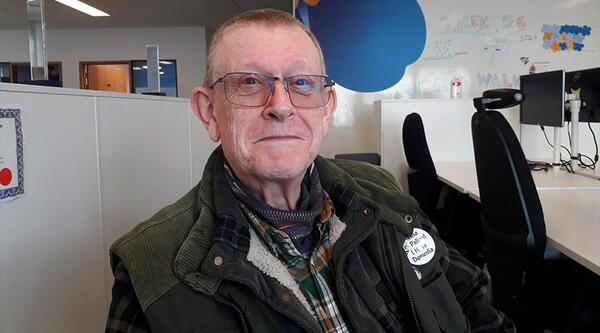
John Teeling, 78, from Coventry, said:
'When I was diagnosed with Alzheimer's disease in my sixties, it came completely out of the blue.
I'd noticed changes in my personality and mood, but I put them down to stress and difficult times at work. It wasn't until I blacked out and had a brain scan that I was referred to a Memory Clinic and told I had dementia.
Being left alone after a dementia diagnosis
My wife Mary and I were shocked, but after being given the diagnosis we felt largely left on our own - it was like being told to go away and die. We were told a nurse would visit, but we then waited several weeks for support and had little idea where to turn for help or what the future might hold.
The need for a joined up approach to dementia
'A few years later, when I was diagnosed with prostate cancer, my experience was very different.'
My PSA levels had been monitored over time, and when they rose, I was quickly referred for tests.
When I received my diagnosis, there was immediate support available. A nurse was there to answer questions, explain my treatment options and help us understand what would happen next. After radiotherapy and hormone treatment, I'm now in remission.
Having experienced both conditions, the contrast was striking.
'Cancer showed me what a joined-up diagnosis and support pathway can look like. Dementia should be no different. People deserve timely diagnosis, clear information and support from the moment they hear the words nobody wants to hear.'
Demand better for everyone affected by dementia
Too often, people are handed a leaflet and left to navigate the system on their own. Stand with us and demand better.