

 Dementia Support Line
Research
The Fidget Widget Toolkit
A project, funded by Alzheimer's Society, has developed a set of tools designed to provide meaningful activity for people with advanced dementia while also involving carers.
Seeing a lack of suitable activities for people with more advanced dementia, Judith Bower and Jane Souyave decided to do something about it.
Judith, internal trainer and Dementia Adviser at the Society in Lancashire, and Jane, Senior Graphic Design Lecturer at the University of Central Lancashire, had noted how often fidgeting and repetitive movements came up in conversations with carers.

Reframing fidgeting
They wanted to dispel the myth that fidgeting is negative or a kind of ‘disruptive behaviour’. Instead, they decided to recreate repetitive fidgeting actions such as turning, twisting, rolling, pulling and flicking movements for positive ends.
They applied successfully to innovation funds from Alzheimer’s Society and the University of Central Lancashire to help develop an intervention called Positive Connections. This aimed to raise awareness of how to communicate and connect with people in the later stages of dementia, when words may become difficult. Judith and Jane hoped to provide opportunities for people with dementia to engage in meaningful activities that could also involve carers.
Work began to design and test their ideas, and this resulted in five wooden, handheld tactile tools that come in a handy pack called the Fidget Widget Toolkit.
How do the tools work?
The specially designed widgets, which use touch, feel and repetitive movements, each with a particular motion; spin, slide, twist, turn and roll, are intended to be unrecognisable, removing any need to rely on memory or words to use them.
Manufactured by Active Minds, a supplier that develops activities for people with dementia, the tool means users are free to get creative, playing and interacting with the tools as they wish, with no right or wrong way of using them.
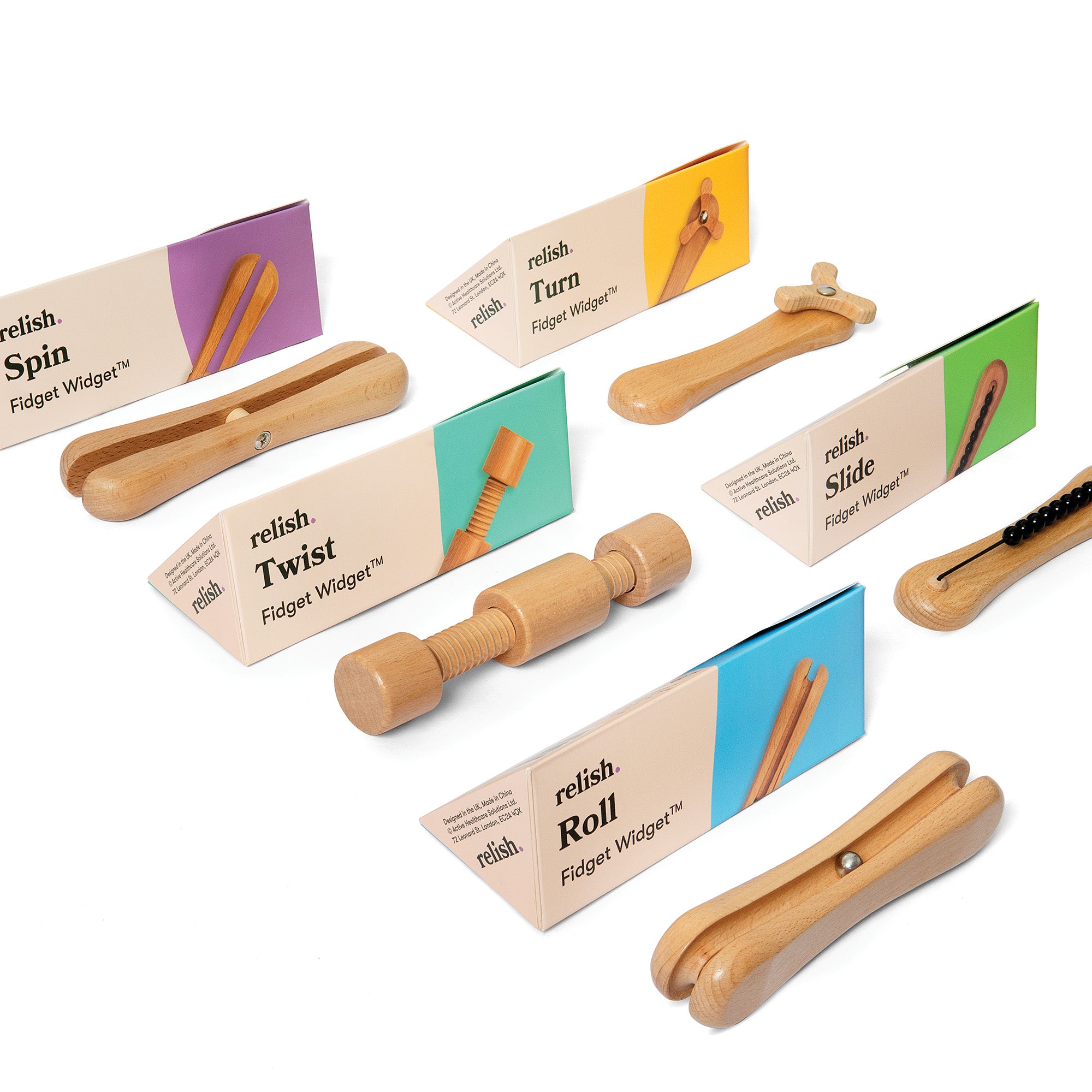
Testing the tools
The tools are designed to not rely on memory or words, and not to represent a recognisable tool, such as a screwdriver or kitchen utensil. This means that people interact with them creatively, with no right or wrong way to use them.
Provided with advice and support by the charity, the duo tested their tools in day centres, care homes, and in people’s homes over a two year period. They found that both men and women engaged with the tools equally, and that families were keen to be involved in using it with their loved ones.
Families, who were supported with techniques to connect and communicate, enjoyed being involved. They particularly appreciated that these were interactions which weren’t focused on providing personal care.
Interactions with the Fidget Widget Toolkit enhanced the person’s wellbeing by supporting their psychological needs to feel occupied, engaged and included in a meaningful activity of their choice. According to carers, this effect was ongoing and lasting.
It’s the only thing he can do for himself, it gives him that little bit of independence.
Comments from care staff included that the tools were ‘simple but effective’ and that ‘the experience changed how we engage with people’.
Fiona Carragher, Chief Policy and Research Officer at Alzheimer’s Society, says:
'The Fidget Widget toolkit addresses an unmet need for people with fidgeting behaviours, a group which can be overlooked or labelled ‘difficult to manage’.
Dementia is a devastating condition, and while our funded researchers are hard at work to find a cure, it’s great to see the brilliant ideas that we have helped make a reality, being employed to help people with dementia right now.'
Buy the Fidget Widget Toolkit
The Fidget Widget Toolkit is available through the Alzheimer's Society online shop.