

 Dementia Support Line
Dementia Strategy and Dementia Companions in Shropshire
In Shropshire, working with people with dementia led to the introduction of a new role, the 'Dementia Companions', who help with personalised care planning.
The purpose
Services needed a shared vision to enable them to prepare to meet the needs of Shropshire's population.
This is expected to be one of the oldest populations in England by 2031, with around 45% of the population aged over 65 years.
Around 5,900 people over 65 and 410 people under the age of 65 are living with dementia in Shropshire.
Dementia Strategy Action Plan Refresh, 2016
Healthwatch Shropshire engaged with 18 people living with dementia, 29 carers, and 17 providers of dementia services.
Using a semi-structured survey –based on the previous Shropshire Dementia Strategy Action Plan– they explored what was working well, what needed to be improved and identified gaps.
Students from Keele University Medical School explored how the pathway for people with dementia was managed in each General Practice.
The recommendations resulting from this informed the 2017-2020 Dementia Strategy and included:
- Raising dementia awareness amongst healthcare professionals.
- GP practices to have a dementia navigator to support and guide the person with dementia and their family through their dementia journey.
- Postponing access to statutory services.
- Encouraging independence in the community for as long as possible, continuing to work towards dementia-friendly communities so people feel included.
Co-produced Dementia Strategy 2017-2020
The Shropshire Clinical Commissioning Group (CGC) partnered with the members of the Health Economy Steering Group, including people living with dementia, to create the new strategy. The latter had been involved in the Healthwatch Dementia Strategy Action Plan refresh work in 2016.
- The CCG used the key areas of the NHS Well Pathway for Dementia to provide a framework around which their collaboration and engagement activity took place, working directly with people living with dementia, their carers and other organisations.
- They came up with a vision to achieve by 2020:
To enable you to remain you, to live well in your community, to feel secure with those around you, to feel confident and informed, knowing where to go when you need help.
Introducing Dementia Companions
The CCG introduced a new model for supporting people with dementia, with the new role of 'Dementia Companion' at its heart.
The role is a new way to help people with dementia and their carers have a more positive experience of living with dementia, and to make the later stages of the journey less distressing
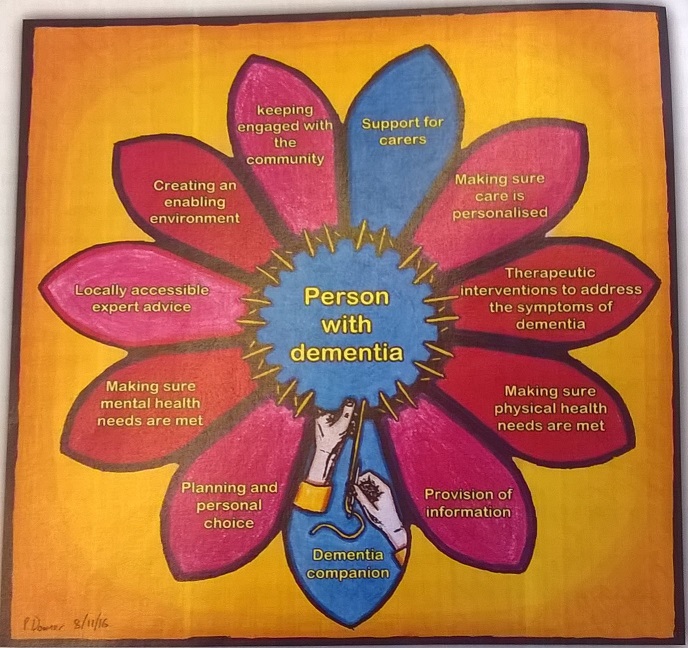
Everyone diagnosed with dementia and, where possible, their carer were to be given the offer of help throughout their journey by a Dementia Companion. The Dementia Companion would be most likely to be employed through a third-sector organisation, such the Alzheimer’s Society.
- Help with planning about future needs.
- Helping the friends and family of the person diagnosed to be dementia aware.
- Encouraging social groups to involve people with dementia in activities.
- Sharing local knowledge of Dementia Friendly businesses, such as taxi-firms, pubs, hair salons, cafes, shops etc. Promoting them to the person with dementia and their carers.
- Promote the importance of ensuring the personal preferences such as when admitted to hospital (for example by using 'This is Me') .
- Assisting carers and healthcare professionals to develop skills such as approaches to communication, activities of daily living, skill training and activity planning.
- Being involved in discharge planning from hospital.
- Providing the dementia carer with a level of emotional support, and signpost on to bereavement support.
The results
There's an increasing number of Dementia Companions. By winter 2017, Dementia Companions had been set up in Newport General Practices. By March 2018, there were two Dementia Companions, provided by Alzheimer's Society, in Ludlow and Oswestry. By March 2019 more Dementia Companions had been created in Shropshire (including Telford and Wrekin).
In late 2018 the Shropshire, Telford and Wrekin Dementia Action Alliance survey of carers and people with dementia reached out to ensure people affected by dementia were involved, not just in its steering group but more people living locally too. The survey found that priorities respondents suggested were still those that the strategy had identified, and that there was still work to do to tackle them.
The Dementia team at Shrewsbury and Telford hospital has been engaging with people with dementia and carers, learning from their experience to improve its provision, including encouraging use of 'This is Me' and making ward and hospital environments more dementia-friendly.
What changed for people with dementia:
There is still a lot not yet achieved, but the strategy is guiding change. Anecdotal feedback and some quantitative measures are suggesting that people are starting to see benefits from the strategy.
- Formal evaluation of the Dementia Companion role has yet to be completed, but already clear benefits have emerged from quantitative and qualitative data. For example, significantly more referrals are being made, and more people being helped to live well with dementia thanks to the Dementia Companions.
- Feedback from people affected by dementia, and frontline staff caring for them, at the Shrewsbury and Telford hospital has been offered immediately and voluntarily on some of the changes they are making and is very positive.
Learning points
At a group discussion in February 2019, Dementia Companions reflections included:
- 'I feel I can help people on things that would be missed otherwise. I can help avoid problems becoming bigger, more complicated and avoid crises happening.'
- 'People often tell me 'it's good to know that you are there and you will contact me, rather than me contact you'. When I first spoke with them, just after their diagnosis, they may have said they didn't need any help. When I call them again a little while later, they often tell me that actually some things have cropped up that they would like some help about.'
- 'Continuity is a bonus - the connection with the person with dementia and especially with their family. We're helping people to stay living at home together for longer, keeping people out of hospital.'
- 'We have much better, closer, relationships with other organisations - much more collaborative working.'
'In the past, people would often reach out for support because something bad had happened, often a crisis. Now that we keep in touch and follow their story, I find there are rarely crises.'