

 Dementia Support Line
Information
Book group: Anna and the Beast by Christine Reddall
We read a moving book from a woman whose daughter was diagnosed with frontotemporal dementia at the age of 37.
Christine Reddall’s preface to Anna and the Beast begins, ‘Well, here we go. Where to start? This is the book I have been meaning to write for quite a long time…’
As a reader, you don’t need long to appreciate why she has so much to reflect on, why it’s so difficult to share, and why it’s so important that she does.
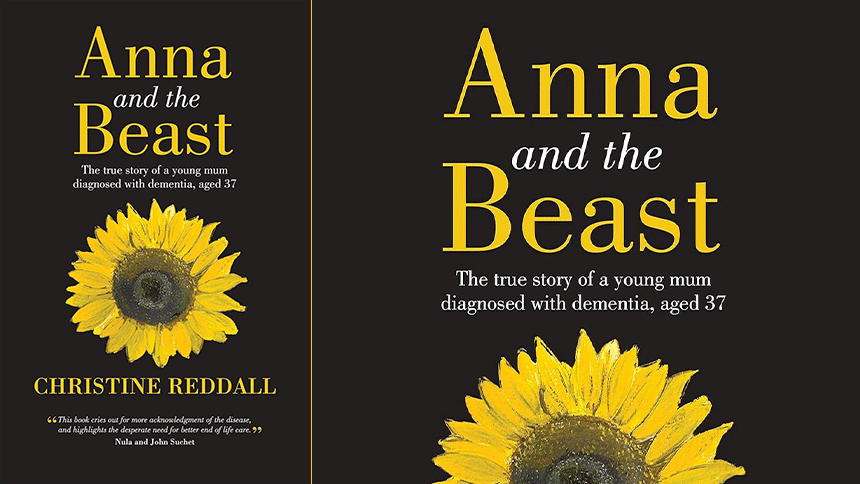
Anna, Christine’s daughter, was 37 when they found out she had frontotemporal dementia (FTD). A nurse like her mother, Anna had two young sons. She died in 2017, aged 42.
Anna and the Beast is Christine’s account of her daughter’s diagnosis and its devastating impact. It also honours Anna’s life, and the second part of the book includes tributes from many who knew her.
Christine finds the right words
‘I have just finished reading this book,’ says Angela in Bristol. ‘Well what can I say, it says everything I could have written myself but couldn’t find the right words.’
‘I read through Anna’s life story in about two days,’ says Amar in Hertfordshire.
I was so touched, it was amazing. I couldn’t put it down.
Carly in Anglesey describes reading the book as ‘an emotional and deeply moving experience’.
‘Christine brings a tender humour to the darkest moments,’ she says, ‘creating light in an otherwise heavy narrative, while also fostering a profound sense of camaraderie, empathy and connection to her journey with dementia.’
A story that resonates
FTD is a less common type of dementia that’s mostly diagnosed in people under 65. It has also been called frontal lobe dementia or Pick’s disease.
People with FTD often do not have memory problems until later on. Anna had behavioural variant FTD, where the first symptoms include changes in personality and behaviour.
Although all types of dementia can affect different people in various ways, similarities between the book and Amar’s experiences of her husband’s FTD stopped her in her tracks.
‘Things like turning the plugs off,’ she says. ‘The blender can be going, and he turns the plug off. The grass is being cut and the extension is plugged into the kitchen, and he turns it off. There was so much to identify with.
‘And the things they had to go through to get it diagnosed!’
‘I’m not going mad’
Carly agrees, ‘The parallels to my own experience with my mother’s Pick’s disease made the story particularly relatable, offering a sense of comfort and reassurance that I was not alone.’
Angela says, ‘I finally found a book that made me feel that I’m not going mad. It resonated so much with the pain and frustration in getting support and services for my partner, due to the nature of this type of dementia.
It is so misunderstood, especially in people a lot younger, and the way it presents can delay in getting an accurate diagnosis.
An insightful and helpful book
‘The book is written clearly and is highly digestible,’ says Carly, ‘exploring themes of anticipatory grief with honesty and depth.
‘Christine’s approach is unapologetically raw, guiding the reader through the stages of grief with an honesty that is both heavy and authentic. The tribute page to Anna was especially touching, offering a personal insight into who she was as a person.’
Amar says, ‘It was hard for me to read other people’s comments – the friends, the doctor, everyone. And my heart, I really felt for Christine. My mum died when I was 25 and I remember my dad sitting myself and my sisters down after the funeral to say, “Look, this is a rite of passage. This is normal, to send your parents off.”
‘But it’s so hard for parents to send their kids off – that resonated throughout the whole book for me. As a parent, you should not have to bury your children. Of course it happens, but it’s not right.’
Angela was impressed by how much helpful information was threaded throughout.
‘The book contains so much information and resources,’ she says, ‘and it is very clearly laid out, with not too much information all together but laid out so you can understand what’s being written.’
Recommending Anna and the Beast
Carly says, ‘I would wholeheartedly recommend this book to anyone navigating the journey of dementia, whether as a family member or a loved one.
‘As a therapist, I would also suggest it to clients who are on a caregiver journey, as it provides understanding, validation and emotional resonance.
‘What stands out most is Christine’s emotional honesty, her experiences are palpable, making the book powerful, relatable and profoundly human.
Anna and the Beast is a heartfelt and moving account that offers connection, insight and solace for anyone affected by dementia.
‘I will definitely read the book again,’ says Angela. ‘I have already recommended this book to other people involved in supporting people with FTD, and they have already started reading it.’
Amar notes that people at different points of their journey with dementia could find some bits harder to read – particularly about the end of Anna’s life and the tributes from friends and family.
‘I don’t really want to see what’s happening much further down the road. I think that was why I struggled with the second half of it,’ she says. ‘I had to take a few deep breaths a few times and put it down and come back to it. Maybe earlier on I wouldn’t have wanted to read it, but I’m glad I did now.’
Amar intends to offer her copy to her adult children and a couple of friends.
‘I’ll show it to them and see if they want to read it. Although my name’s going to go on the inside, so it makes its way back to me!’
Anna and the Beast by Christine Reddall (Goldcrest, 2021), 330 pages, £10.99, ISBN: 9781913719043. Also available as an ebook.