

 Dementia Support Line
Real stories
Documenting the stark realities of caring for a parent who has dementia
Helen Rimell turned her experiences of caring for her late mum, who had young-onset vascular dementia, into a valuable photographic legacy.
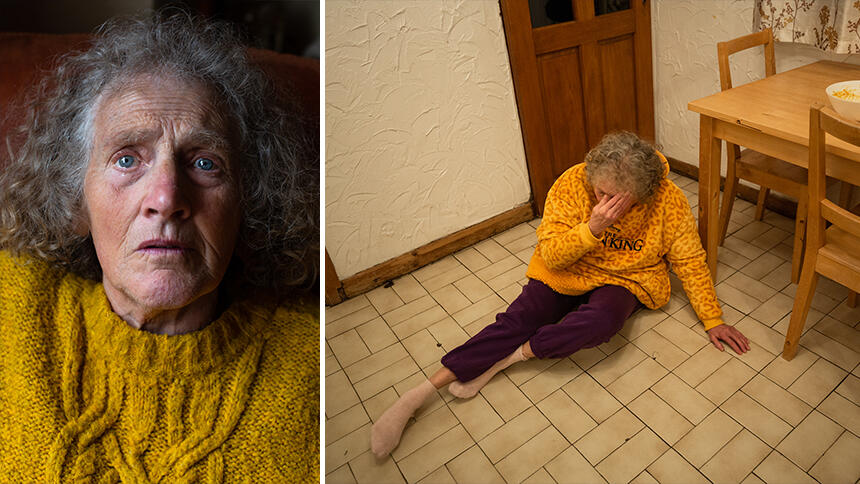
The woman stares into the camera lens, fear and grief pouring out of her brilliant blue eyes. In another shot, she sits on the dining room floor, seemingly in a faraway world of her own.
These are two prints from a striking collection by award-winning photographer Helen Rimell. It records the daily existence of her late mother Sue, who had young-onset vascular dementia.
Helen took thousands of images for the 'No Longer Her(e)' project. One of Sue sitting with her young granddaughter was selected to hang in the National Portrait Gallery, and Helen’s next goal is to bring 200 of the photos together in a book.
‘Mum had a series of mini strokes in 2010, and when she was diagnosed with dementia five years later, I said I’d like to photograph her to show people what it’s really like,’ says Helen.
She agreed straightaway because she thought it would help people, and that’s what she’s always done.
A funny and kind person
Helen says her mum has always looked after other people. She cared for her elderly aunts at the same time when one had dementia and the other cancer.
‘Mum was amazing,’ says Helen. ‘She was so funny and kind and was always doing things for other people.
‘She didn’t have an easy life. She broke up with my dad when I was small, her second husband died and she was then a single parent to three children, but she was always glass-half-full and a ray of sunshine.’
Sue started forgetting things after the strokes but was told her memory shouldn’t get worse if she kept up with her blood pressure medication.
‘She’d always been a bit forgetful and scatty, so we didn’t think much about it,’ says Helen.
I was living in London and she was in Wales, so I didn’t see her every day. But my sister, who lived nearby, noticed she was getting worse and took her to the doctor.
Needing help at home with dementia
By 2019, Sue was being cared for by two personal assistants from 9am to 6pm, seven days a week.
‘She had forgotten how to cook, so they were preparing her meals and giving her meds because she couldn’t remember how to do that,’ recalls Helen.
Covid was particularly challenging.
‘Because she hadn’t been assessed for two years, her medication was wrong, so she got really aggressive.
‘She went into a respite home for a month but they didn’t bath her for 10 days and threatened to section her unless we took her home. It was a nightmare.’
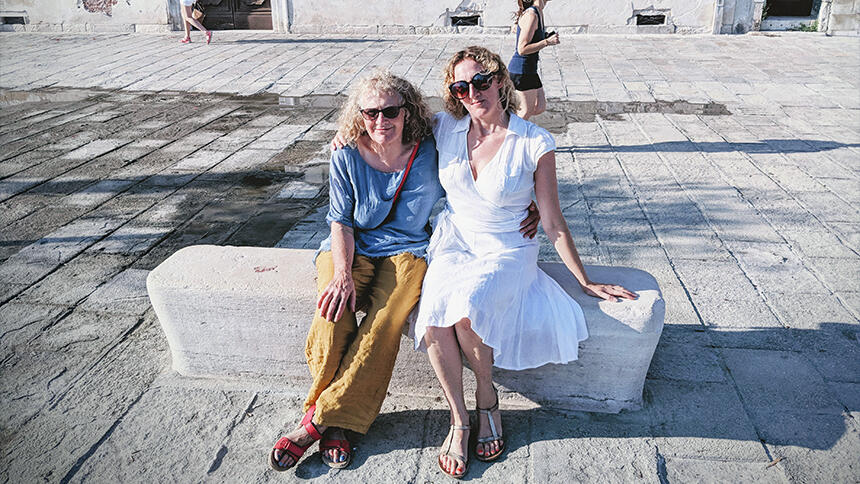
Helen with her mum
Moving to Wales to care full-time
In 2021, Helen’s sister said she felt Sue needed around-the-clock care, and she couldn’t leave her own partner and two children.
‘As a freelance photographer, I can work from anywhere,’ says Helen.
‘And I wanted to look after her. She had always been there for me and I was glad to be able to give back to her.’
Helen offered to move in for a couple of months, but she never left.
‘I planned to shoot a documentary about Mum and then find her a nice home but we couldn’t find anywhere right.
‘She was too manic for a “normal” home and wasn’t bad enough for a nursing home because she could still walk by herself. There was nowhere for someone who was in between, so we decided to keep her at home.’
Adjusting to caring for a parent with dementia
For Helen, uprooting her busy life in London to move in with her mother in a small town in Wales was a major adjustment.
It was a massive shock to the system and I felt very much alone. I could take Mum to groups but there wasn’t anything for carers and I struggled with my mental health.’
Helen is a photojournalist and wedding photographer. She says it was a challenge to balance work with her caring role.
‘I used to do 30 weddings a year but over the last five years this went down to 15, as caring was so time-consuming.
‘I managed financially as I was able to keep my business going, but I don’t know how people do it if they’re not freelance. My sister stepped in with Mum when I was on a shoot, which helped keep my business afloat.
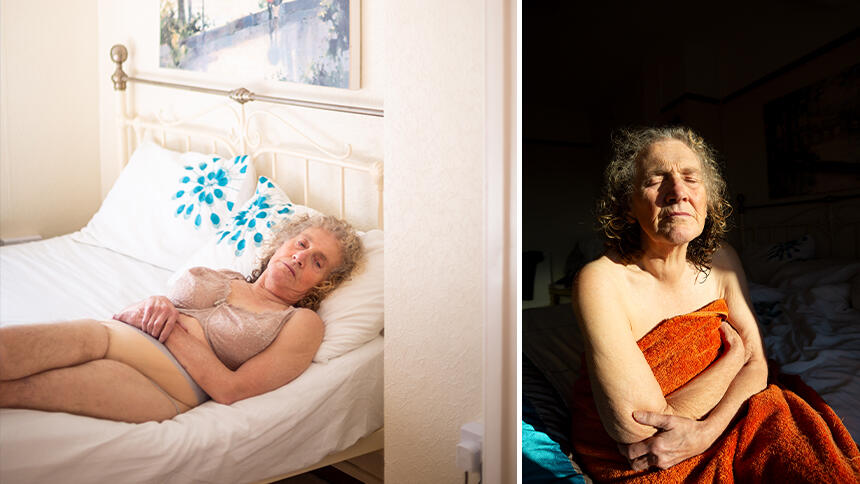
‘In her last few years Mum couldn’t do anything for herself. I would have to feed and dress her and give her a bath.
‘It’s hard physically and emotionally. Eventually she forgot who I was. It was horrific. She was my best friend my whole life. The only one who really understood me and who loved me most, and I don’t know if she thought I was one of the carers.
‘It’s really hard to see your favourite person in the world like this.
‘When she was lucid she would cry, saying she was a burden and that she wished she was dead.
And one time she grabbed my hand and said, “I’m scared because I don’t know who you are.”
Stark reality of dementia
Helen had to learn a lot as she went along, and has regrets about things she wishes she understood more from the start.
‘I wish I hadn’t corrected her when she got things wrong or I hadn’t yelled at her when things got hard.
‘It only upset her and I have a lot of guilt, but I am only human.’
Helen wanted to document the stark reality of caring for someone with dementia, as she believes there is too little attention on this terrible condition.
She highlights how little funding there is to fight dementia compared to other conditions, like heart disease and cancer.
‘One in three of us will get dementia but it is shameful how little is being done to find a cure and how little people know about it.
‘Dementia is a horrible, evil disease where you lose the person you love over and over. You just have to watch and wait.’
An emotional legacy for Mum
Sue died at home in February, surrounded by people she loved and listening to her beloved Elvis. But Helen is determined that her mum won’t be forgotten.
‘I hope my photography project will raise awareness and that my emotional journey will be a legacy for my mum,’ she says.
It’s important to her that the photographs are seen by as many carers as possible. Not out of vanity, but to help people feel less alone.
‘When the BBC ran a story about my collection I got some amazing comments on social media. Dementia happens behind closed doors and carers thanked me for showing what dementia is really like. Some people said, “I could see my own mum in your mum’s eyes.”
‘This personal story doesn’t shy away from raw emotion, but people should be prepared when they need to make important decisions for people they love.’
Before Sue’s dementia became too advanced she and Helen enjoyed a few holidays in the sun. One particularly memorable trip was to Florence.
Helen scattered some of her mum’s ashes there, so she will always be in her happy place.
‘Mum was full of fun so when I organised her funeral I asked everyone to wear bright clothes and we hired two Elvis tribute acts – two young guys so they were hot Elvis!’
Coping with losing her
After Sue died Helen threw herself back into work. A week later, she was in Costa Rica photographing a wedding.
When she came back, she was busy with wedding bookings and planning the funeral.
‘I don’t think it has sunk in yet,’ she admits.
It hit me in Florence because it made me think of her, but most of the time I just try to keep busy.
‘Now she’s gone I feel like I’ve lost my purpose. My dad has Parkinson’s so I don’t know what the future holds for me.
‘I could get hit by a bus tomorrow, so I’m going to carry on travelling and living my life the best I can.’
It sounds like Sue would approve.