

 Dementia Support Line
Real stories
Campaigning to change perceptions of dementia and make it a priority
John Amos, in Hertfordshire, has been involved with all sorts of campaign work with Alzheimer’s Society.
I was fortunate to retire from my job in my 50s. Afterwards, my wife Lesley and I spent quality time with our family, enjoying our hobbies and travelling.
It was a treasured time. Had we worked into our 60s, we wouldn’t have had any time together in a good way.
Because we spent lots of time at home together, I started to recognise subtle changes with the way Lesley was behaving.
She was forgetting things, couldn’t work things like the TV remote and wasn’t able to do puzzles, which she used to love.
Lesley didn’t want to go to the doctors and kept claiming there was nothing wrong. But I, and other people, knew that there was.
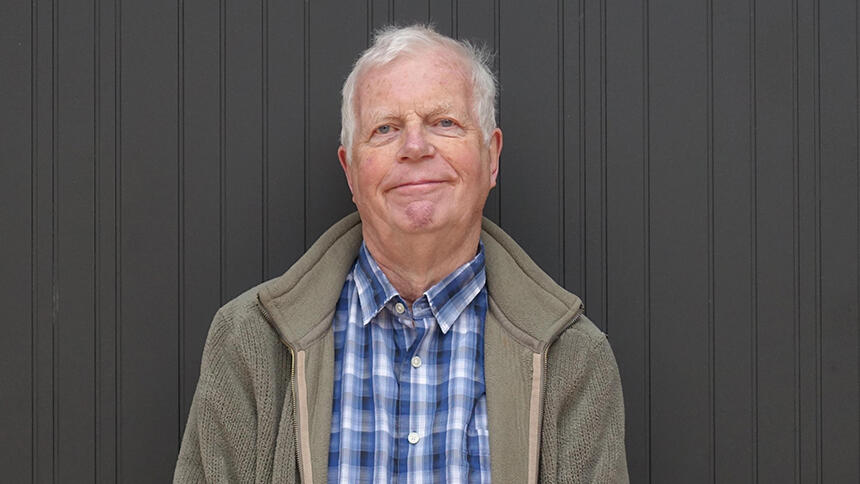
John Amos
Eventually, Lesley was diagnosed with young-onset Alzheimer’s in 2012. She was 62.
Caring for her as she gradually deteriorated was so difficult, particularly when she started experiencing seizures and being aggressive.
It’s hard to know what to do when your wife starts hitting you and saying, ‘You don’t live here.’ That’s when I first contacted Alzheimer’s Society for advice.
The Society also supported me when it was recommended that Lesley go into a nursing home in 2014. It was a reluctant decision for her benefit and mine.
Becoming a dementia campaigner
I’d never done any campaigning before. I’m not a public speaker.
I am placid, but when I wasn’t allowed to visit her care home during the pandemic it really annoyed and upset me.
I thought that it was so unjust that I couldn’t visit, like thousands of other people in a similar situation.
I contacted my MP, the council and government, as many people as I could, to campaign for people to visit their relatives in care homes. I also campaigned for free Covid testing for care home visitors.
Dementia isn’t just memory loss
Since Lesley died in 2022, I continue to speak out.
I just want to share my story.
I’d like people to understand that it’s not just older people that get dementia and it’s not just a loss of memory. It’s a loss of character.
I also want to highlight that carers and family members can be forgotten.
I’ve been to events in Westminster, including a meeting with about 50 MPs. I’ve been to Downing Street. I’m also a research volunteer and I go to groups to encourage people to leave money in their wills for dementia research. I’m still writing to my own MP too.
When I was asked if I’d like to take part in the Casey Commission and share my experiences, I didn’t hesitate to say ‘yes’. This is an independent inquiry that will make recommendations to the government on reforming the social care system.
Broken adult social care system
There’s lots I could have said if we’d had more time. But what I really wanted to get across is the injustice of funding, and the challenges of navigating the social care system.
When Lesley had seizures, the NHS paid for her care. Then after receiving medication to eliminate these, she no longer qualified. We had to self-fund her care, which was totally unfair because she still had dementia.
I think this hit home with Baroness Casey. She came up to me afterwards and thanked me.
A short time after the event, she mentioned my story in a speech to healthcare leaders, which made me feel great.
I’ve recently shared my experiences with Society supporters to encourage them to sign an open letter, calling on the government to deliver a bold dementia plan in England.
I’m surprised by the things I’ve done. I think Lesley would be too!
When I speak with others about dementia, I’m open about it but I’m also determined to get my message across.
I’ll keep fighting. If someone asks me to volunteer and I’m able, I’m there. It’s my way of paying back.
Campaign with us
Be part of Alzheimer’s Society’s mission to create a world where dementia no longer devastates lives.