

 Dementia Support Line
Real stories
As a dementia carer, how can you help research into carer support to progress?
Finding the most effective ways to support carers relies on involving people who know what being a carer is really like.
It’s vital that we know what best supports people who care for a family member or friend with dementia.
This needs research that involves carers themselves, though the demands of caring make this a challenge.
‘You’re so consumed with trying to understand the disease, and the physical and mental impact that it has,’ says De Ward, in the Midlands.
It took me quite a while to think about getting involved in research.
De’s mum was nearly 90 when she was diagnosed with Alzheimer’s disease, and her twin sister was 64 when she got her vascular dementia diagnosis – both within the last three years.
‘Sometimes you feel like there’s nowhere to turn,’ she says.
De only recently began taking part in a study called EnTech, but she’s already felt the benefit of speaking with researchers who are supportive and understanding.
‘The earlier you can get involved, the better.’
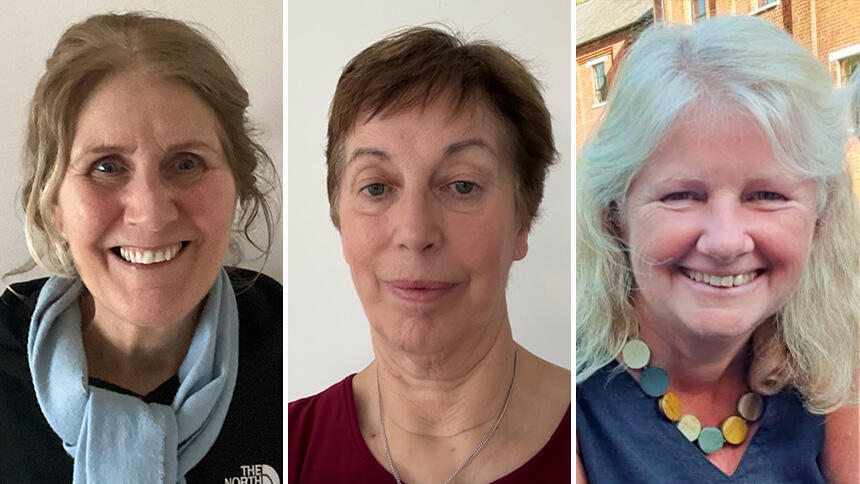
Left to right: De, Amanda and Jane
Making a difference
EnTech is studying how online support can help carers. Sarah Fearn, at the University of Southampton, is one of its chief investigators.
She says, ‘We are speaking to a lot of different people who care for someone with dementia, from people who have never used the internet before to people who regularly use the internet to help them with caring for someone with dementia.’
EnTech’s team includes two people with experience of being a carer – Jane Ward and Amanda Wollam – to help ensure it stays relevant.
Amanda says, ‘One of the difficulties carers face can be finding time to access groups for support, so would benefit from online resources they can use whenever they have time.’
‘Online support has some real benefits in that it is available 24/7 in the carer’s own home,’ adds Jane, ‘and having support available immediately can reduce the carer’s stress both in moments of crisis but also generally as a security blanket.’
Care that goes the distance
In another study, Ayesha Dar is researching what makes a difference for distance carers – something services currently don’t have enough guidance on.
‘My study looks at how health and social care can better support distance carers and the people with dementia they support from afar,’ says Ayesha, at UCL (University College London).
‘By listening to carers’ experiences, the research aims to show practitioners what really helps, so care becomes more supportive, coordinated and person-centred.’
Ayesha is clear about how much this work relies on carers taking part.
By sharing your voice, you can help services better understand what really matters to families and carers, and make a meaningful difference to future care and support.
A rewarding experience for carers
‘Every one of us has different experiences and the more of us who are willing to share our own experiences, the better understanding researchers will have of dementia,’ says Jane.
‘It’s an incredibly rewarding experience, knowing you are making a real difference in the care and treatment of people affected by dementia.’
Amanda says, ‘Participation is a positive way of ensuring that services which are developed are relevant and take into account the views of not just scientists, but of members of the public.’
‘If researchers haven’t got the people to take part, it’s not going to go anywhere, is it?’ notes De.
Another EnTech participant adds, ‘If it is worthwhile, if researchers can gain something from it, then that is good and I am happy to help.’
What dementia research could you take part in?
Research studies offer hope that we can one day end the devastation caused by dementia. Research is only possible thanks to the people who take part.