

 Dementia Support Line
Real stories
How a passion for poetry has continued to help after a Parkinson’s disease dementia diagnosis
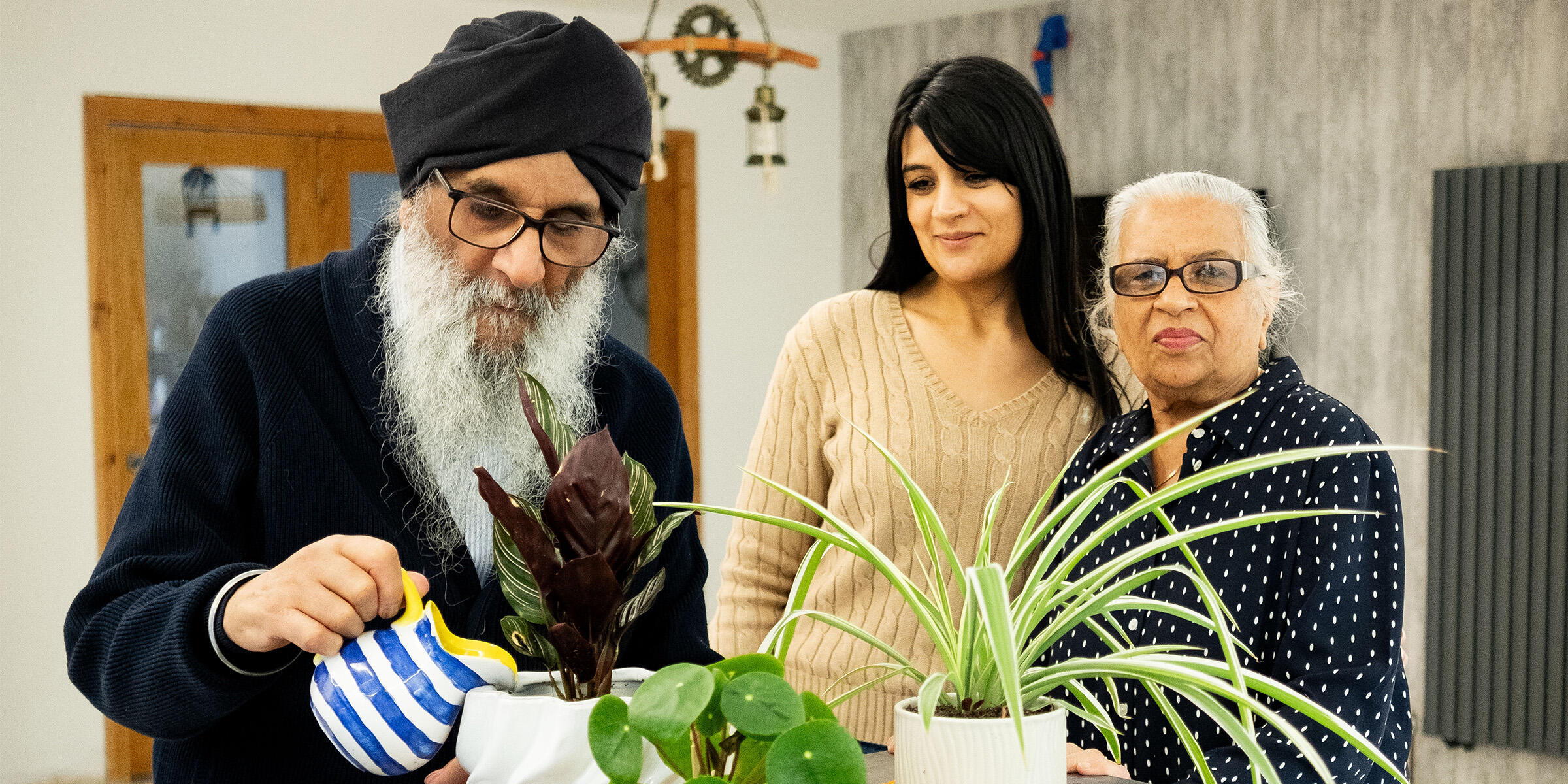
Harjit Singh Sagu, in Leeds, says losing his independence since developing Parkinson’s disease dementia has been hard, but poetry remains a strength.
Being told you have dementia, when you already have a diagnosis of Parkinson’s disease, is a lot to take on board.
For Harjit Singh Sagu, who’s been independent all his life, knowing he would need to be cared for by others felt especially brutal.
But despite this, Harjit, who’s 73 and lives in Leeds with his wife Jasbir, has a special talent that carries him through all his worst times. It continues to bring him and those around him a special joy.
For as long as he can remember, poetry has been his great love, not just reading and reciting poems, but writing them too.
‘From the age of seven, I always had a passion for poetry,’ he remembers. ‘I read poetry books and recited them at events in Punjab, in India.
I still spend hours every day reading poetry and I try to write a poem every day.
Harjit’s daughter Vicki explains, ‘It’s how my dad reflects after an event, or after something happens in his life.
‘Once he had a bicker with my mum, and then he wrote a poem about that. It’s like a reflective moment about what’s happening to him.’
Harjit also uses poetry to teach others, for instance about Punjabi and Sikh history, or the importance of telling the truth, or of men articulating their emotions – in a culture that often does not encourage this in men. His poems are even used to teach Punjabi to children in Sikh temples.
Everything important to him is expressed in the lines he writes.

Finding a ready audience
Harjit was born in Punjab and came to the UK to live with his father and stepmother when he was 12.
‘I didn’t meet my birth mother again until I was 37,’ he says about this tragic separation.
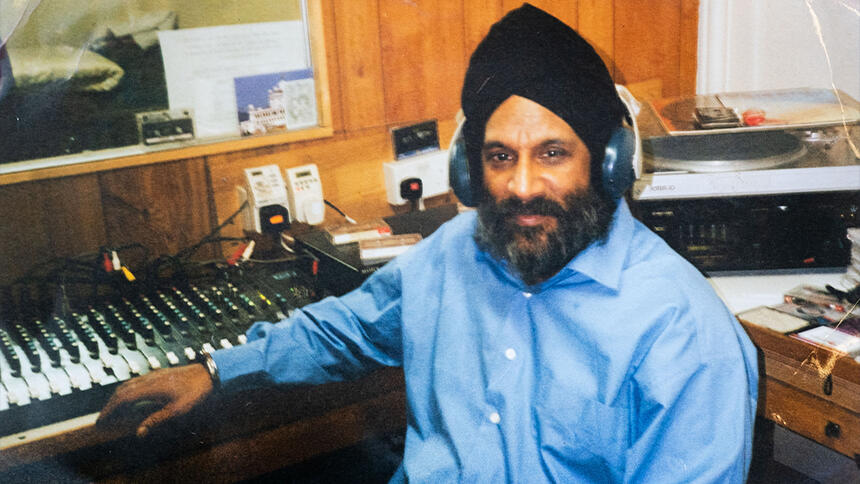
After school, he started work as an apprentice mechanical engineer, then moved to London to work at Ford as a car sprayer.
He returned to Yorkshire to care for his father, who had fallen ill. Harjit stayed in Leeds for the rest of his life, as an engineer, business owner – and poet.
Wherever Harjit worked, he always carried a piece of paper in a pocket to jot down thoughts that might work well in verse. Even when his bosses asked him what he was up to, he carried on.
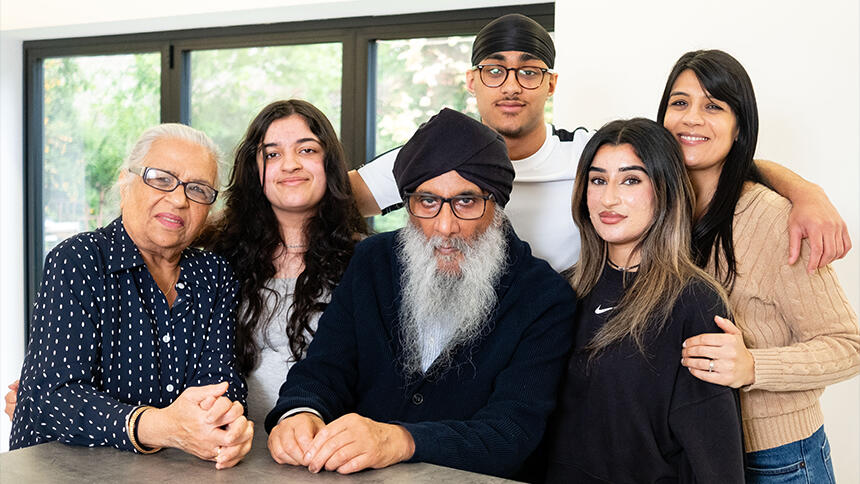
Harjit first met Jasbir in 1973 while in India, and they married the following year. They now have three children and six grandchildren.
Granddaughter Preet says, ‘My grandfather won’t walk two steps without my grandma. They are each other’s heartbeat.’
This explains why, when his wife once had to work on a Sunday – even though this was the special day they always spent together – Harjit wrote a poem about the distance this created between them on that one day.
Vicki remembers Harjit’s impact on her and her brothers when they were young.
‘Every Friday we’d go to the local library with our dad, and we’d get about six or seven books each and read them all week. Then we’d go back the following Friday, until we developed that passion for reading that he has.’
Losing independence
Harjit was diagnosed with Parkinson’s disease three years ago, and Parkinson’s disease dementia last year. Jasbir had noticed his confusion and failing memory and suggested he speak to the doctor.
‘The hardest thing was losing my independence,’ says Harjit, with a tear in his eye.
‘I have always had a clean driving licence, but once when I was driving, I thought I saw someone overtaking me on the left. They weren’t there.
I reported this, and that’s when they took my licence away. That was the biggest thing for me, the worst thing.
Harjit had to overcome many feelings of denial about dementia and accept that this was now part of his life. When he could do this, his life greatly improved.
Now, Harjit attends a weekly dementia group for South Asian people, run by local charity Touchstone, which he loves being part of – and where he has found a new audience. He spends a great deal of time before each meet-up deciding which poem to recite to them that week.
He described his dementia journey to the group one week in his poem ‘Me and My Companion, Dementia.’
In this poem, he expresses, ‘The journey ahead destined to be long,’ and that, ‘One day, without warning came darkness, bringing with it unfathomable winds.’
Touchstone is ‘a shining light’
For many years, Harjit was a volunteer for Touchstone, which helps older people and runs gatherings and yoga sessions. He didn’t expect to be a service user himself.
But he describes Touchstone in the poem as ‘a shining light’.
‘Darkness faded away, as if a dream,’ he wrote. ‘So many souls, witness to my journey.’
The support from Touchstone is what had enabled him, after the shock of being diagnosed, to reconnect with his poetry, and its members were a willing audience to the words he expressed to them:
Sometimes I read alone.
Sometimes, with all
Thousands of travellers.
Our destination the same
Once who were alone
Now stand united.
This poem, like his others, was written in Punjabi. Vicki translated it into English and it was shared in a local Alzheimer’s Society newsletter.

Harjit says attending the Touchstone group is a special time for him.
‘It puts my mind away from other things,’ he explains.
Instead of falling into a negative cycle, he can place his thoughts elsewhere. Many other audiences are on hand to hear his poetry.
Leeds City Council organised a special event for people with dementia and their carers, and I was on stage reciting a poem for them.
He always chooses his subject matter carefully. At a large occasion to celebrate International Women’s Day, Harjit read out a poem about women.
Although he is part of what feels like a male dominated culture, Harjit is an individual thinker and sees life on his own terms.
‘Typically, in the Asian community,’ says Vicki, ‘there can be a bit more favouritism for the boys, but my dad loves everyone, from the girls in his family to the older women he meets in the Sikh temples.
‘He writes loads of poems about the importance of women and what they bring to life. He is a role model for other men in the Sikh community.
‘I think for all of us, Dad’s story is inspiring,’ she adds. ‘He’s gone through so much in life, but even now he remains so positive. I often feel like, with his dementia and his Parkinson’s, he doesn’t let that become an obstacle.
‘He’ll still go to the local temple every Sunday. He’ll still go to yoga twice a week. He will read his poetry.
‘He goes on long walks. He is very resilient.’
Breaking stigma in the Asian community
Something very special, and significant for Harjit, is that he wants to break the stigma attached to neurological conditions in the Asian community.
So he talks at temples and takes part in charity walks, a sign of the passion he has always had for helping others. His last was the Three Peaks Challenge. His next is a hike up Yr Wyddfa (Snowdon), raising funds for the global Sikh charity Khalsa Aid.
You’ll often find Harjit in his garden, continuing to keep it beautiful, or with his close-knit family around him.
But mostly you’ll find him at his laptop, writing his next poem. Soon, thanks to popular demand, his poems will be printed in a book, to gain an even wider audience.
Harjit doesn’t let his diagnoses define him.
‘My advice to others is to keep your mind clear,’ he says. ‘Keep yourself distracted.’
‘He’s like a ray of sunshine for us all,’ adds Vicki. ‘A light of hope for all the others with dementia.’
How you can help
Your donation helps us to support more people like Harjit to remain as independent as possible.