

 Dementia Support Line

Real stories
Creating your own path in life with young-onset Alzheimer’s
Chris Green, in Worcestershire, has never let others stop him finding his own way in life. He brings the same spirit to life with dementia.
Chris Green struggles with his memory because of Alzheimer’s disease and learning difficulties, but he has never forgotten when he fell in love with music.
That feeling is as clear today as it was when, as a schoolboy, he heard a teacher play a few lines from pop group Simply Red. His fascination was instant.
‘I thought, “Who is this band?”’ says Chris, now 54.
I read up on them and found out the lead singer, Mick Hucknall, had come out of a punk band. I thought, ‘Oh, that’s interesting.’
In that moment, he realised there was a whole world of music ready for him to learn about and explore.
Ever since, music has played a central role in his life, carrying him through when times were tough.
Believing in his underlying talent
Chris has faced a lot of rejection, but the soundtrack to his years has kept him confident of his underlying talent.
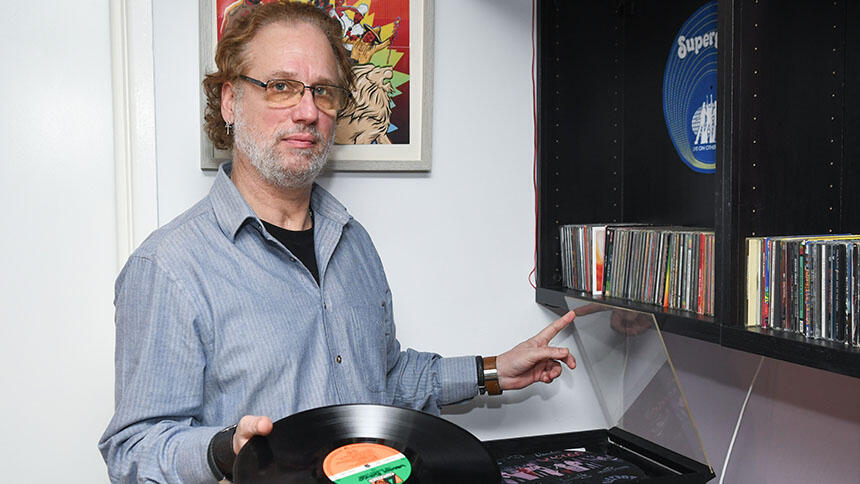
It’s led to him working as a DJ. He mixes, edits and creates tapes that have entertained community centres, dementia cafés, support groups and many more.
When he thinks about his musical taste, Chris has spotted a pattern: he never follows the crowd but looks for those who rebel, in the way he has always done.
‘With the Wailers, everyone goes on about Bob Marley, but I was more of a Peter Tosh fan,’ he says.
I always drive towards people who are a bit more militant.
This is the kind of music Chris relates to because of the struggles in his own life.
His learning difficulties and dementia are not always apparent to people when he first meets them, often leading to confusion, misunderstandings and fallings out.
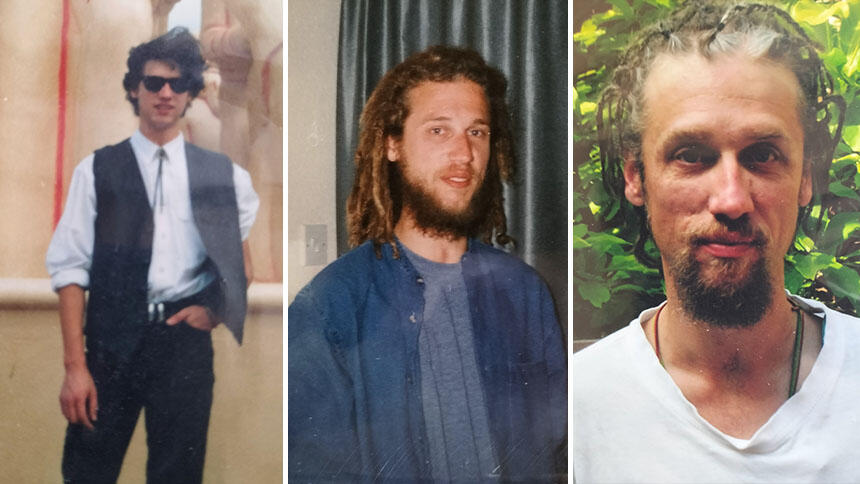
Chris when he was younger
Complex surgery as a baby
Chris was born with a heart condition and had complex, pioneering surgery at just three months. The risks included the possibility that he might stop breathing soon after being operated on.
This is what happened to Chris, and that’s when his brain damage occurred. Due to this, he found school difficult, but some teachers supported him, including his English teacher, who was the one who played the Simply Red track, that had such an impact.
After school, Chris progressed to training courses and the job market.
‘The system didn’t work,’ he says, looking back.
‘I have dyslexia, colour blindness and memory problems. What takes people five to 10 minutes will take me an hour.
I would get sent for jobs but, when I mentioned disability, the interview would be over.
Chris says he also has problems reading body language and understanding social boundaries, and that has upset people. When he finally gained an official diagnosis of learning difficulties this helped explain his behaviour to others.
‘Before this people thought, “Chris is difficult,” not, “Chris has difficulties,”’ says his mum, Cathie.
‘So people would judge him, which was very difficult.’
However, despite the diagnosis, he still struggled to find long-term work.
Instead, he started travelling, with the help and support of his family, and volunteering, including taking stints tidying up at Glastonbury Festival.
Feeling validated by a diagnosis
A few years ago, Cathie noticed Chris’s memory was getting worse. Their GP, a great support, suggested memory tests and these led to a CT scan.
Next came an Alzheimer’s diagnosis. Chris says that, maybe surprisingly, this didn’t feel like as much of a gut punch as people might expect.
'The symptoms for dementia are the same as for my learning disability,’ he explains.
In fact his diagnosis of dementia was a time when he felt validated.
‘People still didn’t believe I had any problems, but I made the point to them that the letter states what I’d been saying all along and people hadn’t believed me. Now perhaps they can accept that I’ve got difficulties.’
However he believes professionals struggle to help people who have both dementia and learning difficulties. When one charity organiser told him he needed to make his own way across a town he didn’t know – on buses he hadn’t heard of – to join a group, he was dumbfounded.
‘What I have is a different experience to most people with dementia,’ he says. ‘We’re not all the same, so I’m having to explain a lot to people.’
His appearance sometimes adds to others’ confusion.
‘I really do like to defy norms,’ says Chris. ‘I had dreadlocks until recently and people really did get freaked out by me.
I like to be shocking. No one expects someone with dreadlocks to have dementia.
Creative and positive about life
Chris’s life experiences have taught him to make the most of his time.
‘You learn to be very creative about your life and what you can do,’ says Chris.
‘With the help of music, I’ve found it easier to switch off from my problems. I’ve been isolated, but music has given me opportunities. I’ve always just been fascinated by it.’
He’s also had positive life experiences in his campaigning activities.
I was involved with the Twyford Down demos, the M11 link road campaign and the poll tax protests.
‘They were really good. It was the camaraderie and the way we all kind of got on.
‘No one ever said to me did I have a learning problem or that I was a bit weird. It was, “Let’s just go for it.”’
Chris talks about his love of gardening as well, and he hopes to take over a local allotment with the right support.
‘I will grow veg. I’d rather grow it myself and eat it because I know what’s in it, where it’s coming from, and it’s got no chemicals in.’
Getting the support to thrive
Chris recently moved from West Midlands to Worcestershire to be close to Cathie, so she can help him with meals and everyday tasks.
This has given Chris the support he needs to nurture a softer side, shown in his relationship with his daughter, who’s 21, and in his volunteering. He likes being part of something and being accepted by a team.
‘I’ve had enough of trying to prove myself. That’s been my attitude since I hit 50.
I know that with music I can switch off from everyday life and go into another world. I have my perky moments.
When he takes music into his dementia world, Chris says he’s helping to spread the word that dementia doesn’t only mean people in their 70s, 80s and older. His mix tapes are fun, full of great tunes, and personalised with voiceovers for the group they’re for.
Chris recalls one dementia group deciding to bring music into their meetings, and the other members were suggesting Dean Martin songs and other names from a bygone age.
Chris intervened by rewriting The Clash song 'Should I Stay or Should I Go' for the group. His lyrics began with: ‘Darling you’ve got to let me know… where I put my shoes. Some days I’m all confused…’
He sang it and played it to them. It was an instant hit.
‘Everyone was in stitches,’ he says.

Opportunities to do well
For the future Chris wants to keep working with music and remixing. He wants to keep spreading his message that dementia includes rebels like him who have taken part in protests and who live fulfilling lives in a different way.
Life feels settled now he’s living close to his mum. He’s volunteering for a local community centre with a friend and it’s going well.
The centre organiser has just bought a PA kit, and Chris plays the music at events for her. She is giving him opportunities in an environment where they accept him for who he is, says Cathie.
‘We held a Mistletoe Festival at the centre just before Christmas, and I was doing the music,’ says Chris.
‘Afterwards we went into the pub for a drink and people kept saying, “That was the best Mistletoe Festival ever. You’ve upped it with the music.” They were saying, “That’s down to Chris because he’s good at it.”
I’m not used to people giving me compliments, so it’s a bit weird.
Weird maybe, but welcome. With his catchy tunes, special effects and great local support, Chris has come into his own.
How can you help?
Your donation helps us to support more people like Chris to remain as independent as possible.