

 Dementia Support Line
Real stories
Every blood sample matters when researching tests for dementia
Researchers are looking for a wider range of people to help find which blood tests will transform how dementia is diagnosed.
‘Don’t underestimate the amount we still have to learn,’ says Professor Liz Coulthard, who leads the READ-OUT trial at the Bristol Brain Centre, Southmead Hospital.
This UK-wide study is finding out which simple blood tests will make it easier for anyone to get an accurate diagnosis of dementia.
‘Alzheimer’s and other forms of dementia are caused by really complex diseases,’ says Liz, a consultant neurologist.
So, each blood sample actually contributes a huge amount to learning how different people are affected.
READ-OUT is especially keen to involve more people from Black and Asian communities, as well as from all kinds of socioeconomic backgrounds.
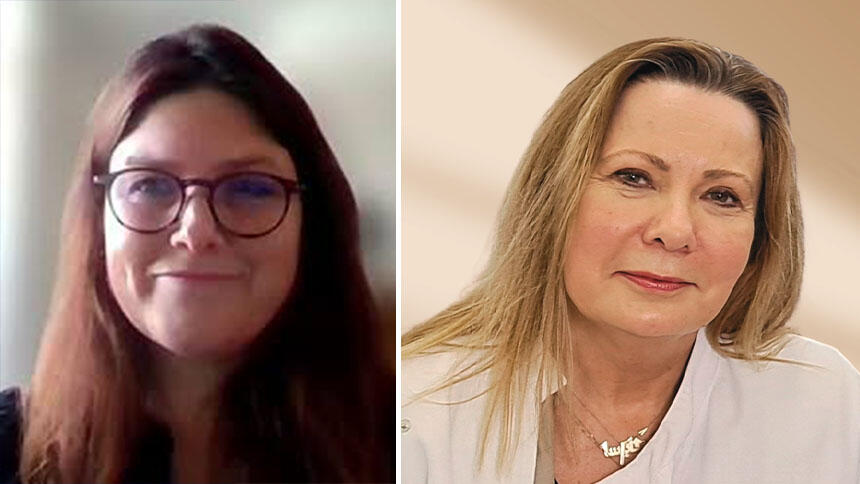
Liz Coulthard and Vanessa Raymont
Professor Vanessa Raymont is one of the trial’s national leads. She underlines the impact of taking part.
‘Both my parents died with dementia. I hope that the kind of experience they had will change quite drastically in the next few years.
‘If we can show that these tests help us make a more accurate diagnosis, we should have a framework that we can roll out across the NHS.
This is a chance for people to get involved with something that could actually change memory clinics very soon.
Simple tests for dementia
READ-OUT is part of the multimillion-pound Blood Biomarker Challenge. It’s finding out how blood tests could be used across the NHS to transform how people are diagnosed with dementia.
Vanessa, a consultant psychiatrist and Associate Professor at the University of Oxford, has worked in many memory clinics.
‘They’re not necessarily in places where you have access to scans or are able to do complex tests,’ she says.
Vanessa says simple blood tests could be a ‘gamechanger’, but we need to know which tests work best for different people.
‘We have to make sure this works for everybody in every clinic.’
Including more people in research
READ-OUT involves over-45s who have a memory problem that’s being investigated or monitored. They have blood tests, answer questions and share their medical records.
To include more people, Liz’s team has reached out to Chinese, South Asian and African Caribbean groups in and around Bristol. They’ve also worked with local media.
‘When we’ve advertised the study, we’ve had lots of people phoning in who want to take part,’ she says.
‘These are small steps to try and improve diversity but we hope that, added together, they will have an impact.’
Determined to help
Paul Cliffe, in Dorset, volunteered for READ-OUT because he knows the importance of an accurate diagnosis.
Paul, 64, has young-onset Alzheimer’s disease. He says he always felt he was a ‘prime candidate’ because of his father’s dementia.
‘I can remember my father being like this and we all said, “Oh well, that’s just me dad, you know.”’
He’s determined to help improve other people’s experiences of dementia.
If I can contribute in some way and help someone else going through this, that’s what I want to do.
Paul has his sights set on research resulting in better treatments for everyone.
‘The thought that, one day, there could be the “golden bullet” – that would be fantastic. It won’t be in my time but I’ve got two boys, and perhaps it will be for them and others.
‘I would encourage anyone thinking of taking part – don’t delay, get involved!’
What dementia research could you take part in?
Speak to our Research Participation team – email [email protected]
The Blood Biomarker Challenge is a multimillion-pound initiative led by Alzheimer’s Society, Alzheimer’s Research UK, the National Institute for Health and Care Research, Gates Ventures and players of People’s Postcode Lottery.