

 Dementia Support Line
Real stories
Caring for a parent with dementia when you’re an only child
Nupur, in London, has had a steep learning curve since her dad was diagnosed with vascular dementia and wants to share her experiences to help others.
Although she witnessed her grandfather living with Alzheimer’s disease during her teens, Nupur admits she was ‘naive’ about the huge impact of dementia.
‘I’d describe life since dad’s diagnosis in 2024 as nothing short of a steep learning curve.’
It’s hard to say when her dad Bulu, a retired radiology consultant, first showed dementia symptoms.
But Nupur was aware that both he and her mum, Protima, now both in their 80s, had aged noticeably during the Covid pandemic.
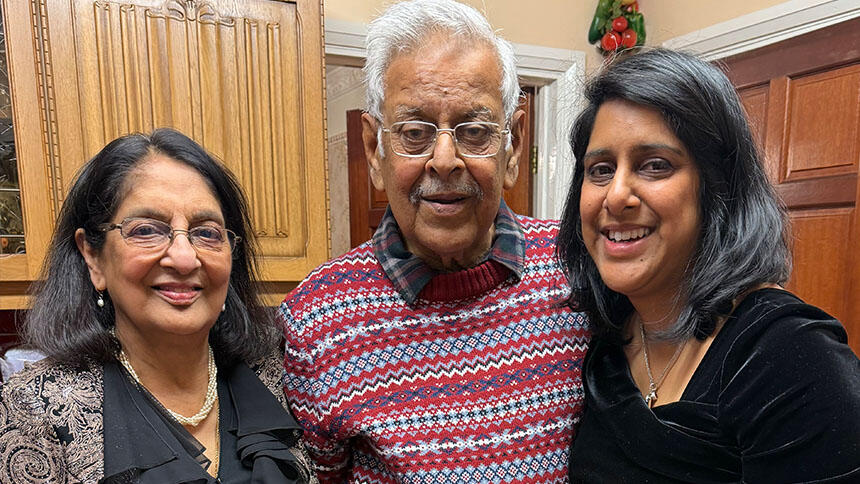
Noticing early dementia symptoms
‘I live in London and during my recent visits to Nottinghamshire to see my parents I noticed he was getting forgetful.
‘I was having to repeat things again and again, but his hearing wasn’t great, so I wasn’t sure if it was down to this.
‘I was also worried about his spatial awareness when he was driving. I was always on edge. At the supermarket I’d be saying, “Let’s find the widest space to park!”’
After voicing her concerns with her mum, a former GP, Nupur encouraged him to see his doctor.
‘And that’s when our journey started,’ she continues. ‘After a second appointment, he was referred onto a local memory clinic and from there for scans.’
Bulu’s scan showed multiple bleeds on his brain and he received a diagnosis of vascular dementia in November 2024.
Nupur recalls it being a shock but tinged with relief for her and her mum.
They also felt a ‘sense of luck’ that they’d been able to get a relatively quick diagnosis.
‘I think dad medically understood his diagnosis, but then he’d forget and be insistent there was nothing wrong with him and he was totally OK.’
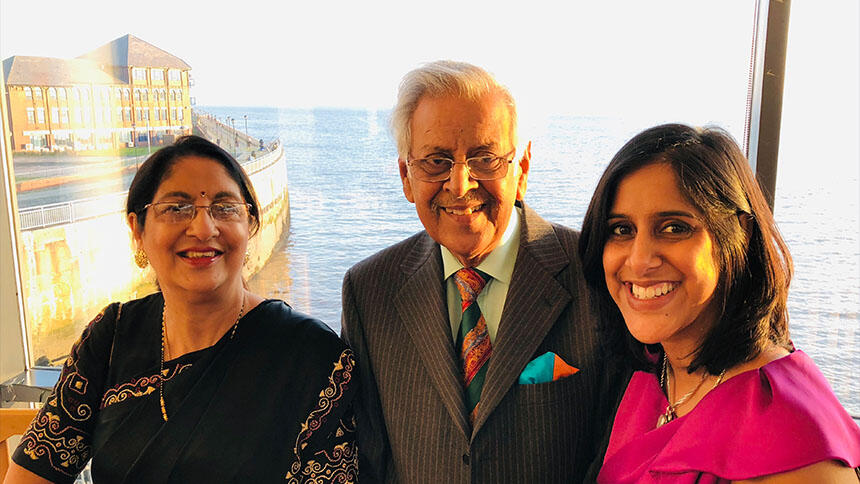
What life was like before dementia
Nupur describes her parents as energetic, dedicated and hard working.
‘Dad came to UK from India in 1966 and mum in 1972, then they married in 1975. I’m their only child.
‘They both had a tough time initially coming over and faced lots of prejudice and barriers while they were trying to establish their medical careers.
‘But dad was always strong-willed and he enjoyed socialising and meeting others.
'Mum was quieter and fully focused on becoming a GP, eventually running a practice by herself.’
Nupur says they always wanted the best for her and encouraged her independence. She also embraced their passion for travel.
‘When I was younger, we went to the US, Canada, India, the Far East and around Europe, so I was very blessed.’
‘Mum had hopes and dreams of more travel after she retired in 2015. So there is some frustration that she’s not been able to do this. As well as looking after dad, she has health concerns of her own.’
In fact, it was during a family trip to India shortly after Bulu’s diagnosis that Nupur says she had a ‘stark realisation’ about his dementia.
He’d always been so strong and physically fit, but dad was disorientated and so vulnerable during the trip.
‘He just kept asking me over and over again where we were, what we’re doing. The heat also really affected him and he became dehydrated and weak.’
Making financial and legal decisions
Back in the UK, Nupur, who describes herself ‘incredibly practical’, was focused on getting her mum and dad’s financial and legal affairs in order.
Having trained as an accountant, Nupur assumed this was something she could confidently manage.
Although they’d not talked openly about money as a family, her parents had previously set up wills and powers of attorney.
But things didn’t pan out as smoothly as Nupur anticipated.
‘One of the first obstacles was removing mum and dad from each other’s power of attorney, to have me registered.’
Then Nupur had a year-long battle contacting banks and utility companies to be able to manage her dad’s finances. In turn, this has triggered unexpected emotions.
It’s tricky trying to support dad’s independence but also being mindful of his dementia.
‘I give him a small amount of cash, but he has a habit of mislaying it. This has led to him feeling frustrated.’
Her other focus has been streamlining the ‘mountains’ of paperwork that her dad has accumulated over the decades.
‘For years I’d asked him to tackle the piles that have built up in a spare room and the garage. This is something I’m now doing and it’s such a mammoth task.
‘You name it, he kept it, from bills and bank statements going back years to flyers and magazines, including the free ones you get in supermarkets.’
Dementia care is a juggling act
Understanding what dementia care works best for Bulu has also been a learning process.
‘I think that is something lots of families affected by dementia will be familiar with.
Because care is not a one-rule-fits-everybody situation.
Alongside support from their local community hospital, Nupur says advice from Alzheimer’s Society has been invaluable.
‘Our dementia adviser Rachel Briggs is absolutely a tour de force, particularly in terms of explaining what benefits my parents are eligible for.’
The family have support at home from a carer, Kirsty, who Bulu gets on well with.
Nupur says that as she and her mum have developed a routine around Bulu’s dementia, they have opened up to other people.
Support from her parents’ community and friends has been heart-warming and unexpected at times, she explains.
‘My dad’s car was his pride and joy and, when he could no longer drive it, it was sat on the drive like a permanent reminder of his loss.
‘But an ex-colleague of my dad’s, who’s recently retired, got it fixed and now takes mum and dad out in it regularly. ‘It’s just brilliant that it’s gone to somebody dad knows and they can still enjoy it.
‘Having some wider support like this has been invaluable as I don’t have siblings or any other family to share the load with.’
Finding support as a dementia carer
Nupur has found ways to encourage her mum to rest and recuperate from her caring responsibilities.
‘Obviously, a person with dementia needs lots of help, but carers get forgotten.
Carers are working 24/7 in a very physically and mentally tiring, largely thankless position.
After dealing with strong feelings of overwhelm and a loss of identity, Nupur says she’s also ‘turned a corner’ with her own personal wellbeing too.
‘In the space of two years, I felt like I’d lost my identity as a highly qualified professional and become a full-time project manager for my parents.’
Counselling has helped her process what’s she been through.
‘My counsellor helped me put my situation into perspective and put some strategies into place. For example, when I come back to London, I try and do some nice things for myself. And I’m very lucky that my husband is supportive. Having a strong support network is key.’
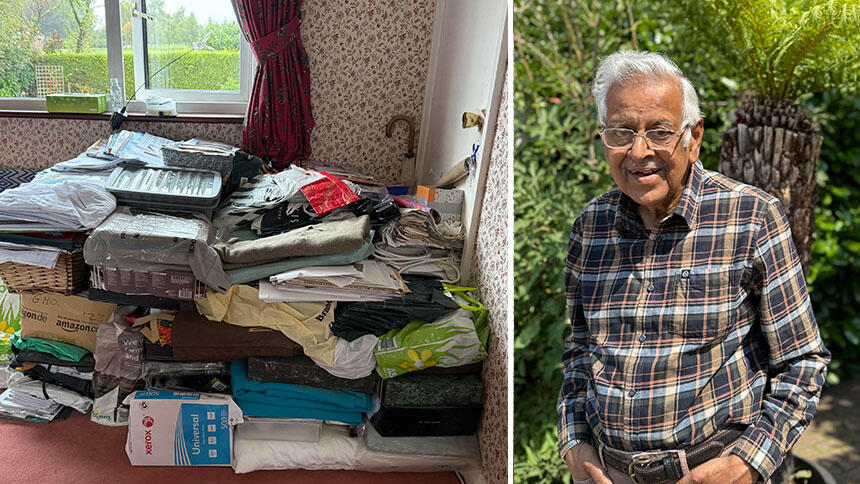
A paperwork stack and Bulu
The importance of planning for the future
Nupur, who retrained as a financial coach, also wants to channel her experiences into helping others.
She’s passionate about encouraging open conversations about dementia.
She’d also like to use her finance skills to educate people about topics such as wills, powers of attorney and inheritance tax.
‘I want to use my finance background to guide others on how they can start conversations about finances and about the type of care they want and how they want to be cared for when they’re older.
As a society we need to get better at having these open conversations, especially with people living longer.
‘It’s never too early to start talking.’
Staying hopeful after a dementia diagnosis
Throughout the range of emotions Nupur’s experienced since her dad’s diagnosis, there is still hope.
‘It is so sad seeing him getting confused, being forgetful and lost.
‘But he’s at home, still in familiar surroundings and generally is in good humour and is happy.
‘We are very fortunate that dad, who used to be quite hot-headed, is mostly a very gentle person now.’
Alongside her practical caring responsibilities, and tackling those mounds of paperwork, she makes sure she spends ‘fulfilling’ quality time with her parents.
It’s hard to carve out this time but she encourages others in her situation to make it a priority.
‘I turn 50 in a few months, and although I feel like I’m not in a place I expected to be at this age, I also feel lucky. I’m lucky that my parents are still around and I can still enjoy time with them.’