

 Dementia Support Line

Real stories
Meg and Keith's experience of dementia with Lewy bodies and Parkinson's disease dementia
Adjusting to life after diagnosis is challenging for people living with dementia and their carers. Meg Wilkes explains the impact of her husband Keith’s move into residential care, following his diagnosis of dementia with Lewy bodies.
This personal account was written by Meg while Keith was in residential care. Meg gives a carer’s view of how the condition took hold and transformed their lives together.
Enjoying moments with family was so important, but many couldn’t see how ill Keith was.
In our student days, I fell in love with a lively, clever, creative, athletic, thoughtful, deeply spiritual young man with vision and great skills in communicating. He graduated from Cambridge with a science degree, before becoming a priest in the Church of England.
We married in our 20s and had two children, trying hard to combine family care with a demanding working life.
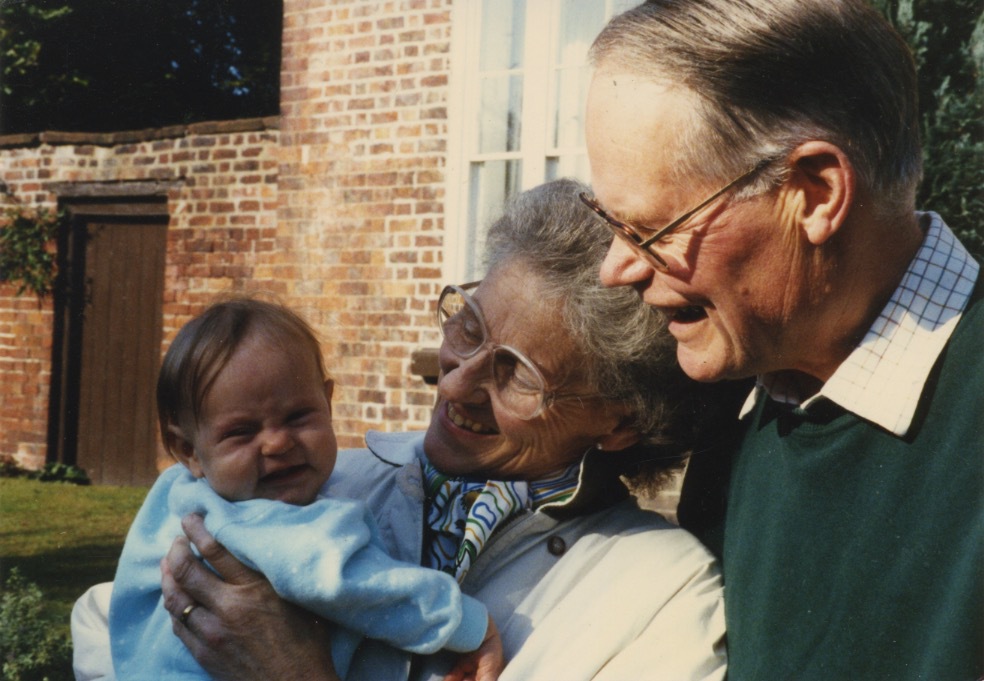
A life transformed
We are now in our early 70s. My husband is in a nursing home in a Special Unit for Elderly Mentally Infirm patients, living as best he can with Lewy body dementia.
He has to be fed, washed, dressed and helped from bed to wheelchair. He sits slumped, like a puppet without strings. He is doubly incontinent. He is unable to read or write or to control the radio, TV or phone.
He sleeps a lot and often keeps his eyes closed when he is awake. His hallucinations are vivid, sometimes disturbing to him, always detailed and clear. His speech is mostly incoherent and so quiet that few people can hear him.
His attention span can be measured in seconds and rarely lasts a whole sentence. He seems unable to distinguish between his dreams, his waking thoughts and what is happening around him.
My heart aches to see him like this.
Longing for affection
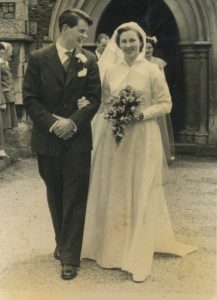
Our marriage in 1955
When I arrive he greets me briefly, often with a smile, though sometimes he doesn’t know me. I long for some sign of affection, some reassurance that I am still special to him. Mostly, I have to be content that I am the one he takes for granted.
When visitors come, he usually responds for a few minutes, especially if they have connections with his work. At other times he will resist or reject their approaches. His lifelong conversational skills can mask his lack of understanding. His habitual response, ‘yes’, means, ‘yes’, ’no’, or, more often, ‘I know that you have said something and I’m trying to fathom its meaning’.
Now and then he astonishes people with a sudden burst of energy and determination, getting up quickly and walking.
This usually ends in a fall. I have come to associate these times with talk of trains and journeys, which symbolise escape for him.
There are fleeting, infrequent times when his thoughts are clearer. He might remark on events, perhaps asking after people we know or commenting on his care. I am with him for several hours every other day, witnessing the relentless progress of the disease.
I rejoice that he has excellent care and I grieve for the husband I knew.
Learning together
A frequent cry from carers is ‘no one can understand how it is unless they’ve been there’. It must be equally true for those we care for. None of us has the full picture.
I am sure that understanding and knowledge will grow if professional and informal carers are more honest with each other, more courageous, trusting each other’s expertise.
Dementia with Lewy Bodies is a horrible illness. Anything we can do to be more effective will be worth the effort.
We look like any normal couple of our age, but life was far from easy.
When my husband’s illness was diagnosed as atypical Parkinson’s, he was afraid that he would be written off by friends and colleagues, so we kept it a secret for a couple of years. My husband is a walk-away man, I am a talk-it-through person. What had once been a happy mix was painful exaggeration.
We were becoming strangers. We kept up our public image, but home was a cheerless place. The medication helped him physically. When he did share his news, people judged his condition by their knowledge of Parkinson’s and assumed that he was little affected, particularly as he showed none of the expected tremor.
I tried to share my worries of his dementia symptoms but it was always the same - people dismissed them with ‘explanations’, hinting that I had unreasonable expectations. I questioned my own perceptions.
Shrinking worlds
At work, colleagues’ apparent expectations put an enormous strain on Keith. It all became such an effort for him that he shrank his world to what he saw as the essentials. He tried so hard.
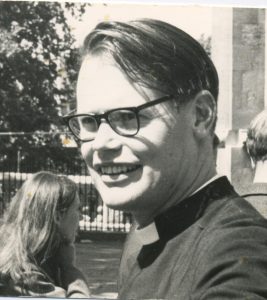
Keith in younger days, enjoying life and work
It was a relief when he decided to take early retirement. It would have been a bitter blow for him to have continued until he was asked to stand down.
It was a difficult and painful decision for him, as his work brought him into contact with interesting and stimulating people. It was his life, not just a job.
He was scarcely aware of his declining ability and planned to write another book in his retirement. The book was never written.
Losing touch
A few years into his illness, as well as avoiding eye contact, he told me he didn’t like me touching him. Even holding hands as we walked or accidental contact indoors was unpleasant for him. I must just watch him if he fell, not try to help him up. He told me all this in a light, matter of fact way as though it was a trifling matter.
It persisted for years except for an occasional time when he denied it all and said I must be mentally ill to say such things. There were times when I felt the need of some comfort and asked him if he would give me a hug. He couldn’t. I found it acutely painful.
To me, touching is a way of expressing love. It felt like a punishment, banishment, an over-harsh reaction to my shortcomings.
He did some potentially dangerous things - shattered a glass dish by using it on the gas cooker, turned on an electric fire too near to furniture, took my medication. I couldn’t relax for a moment.
He walked out of hospital in a snowstorm, without a coat, the day after he was sent for investigations following collapse and was missing for five hours. At home, he would set off to do something, apparently forget before he got there, forget that he had forgotten and later assure me that the job was done.
Dramatic moments
The worst example of this was his once-regular chore of keeping the rainwater drain from the roof free of debris – a tricky job he insisted on doing himself. Very soon after it was ‘done,’ we had a heavy downpour in the middle of the night. Ceilings on the top floor collapsed, the water poured down the stairwell.
As I clambered about on the flooded roof in nightie and wellies and my husband rested calmly in bed, I realised that in many ways I was now on my own. I raged to the night sky but resolved to survive. It was a dramatic moment, now a strengthening memory when things get hard.
He did remember later that he had ‘forgotten’ to do the job. I think it’s more likely that he couldn’t bring himself to admit that it was beyond him. Poor, dear, once vigorous and talented man.
My deep and shameful regret is that he shared so few of his fears with me.
Male friends have told me that he would have seen it as a matter of pride, of not wanting to worry me, wanting to go on being the supportive husband he wished to be. I shall never know.
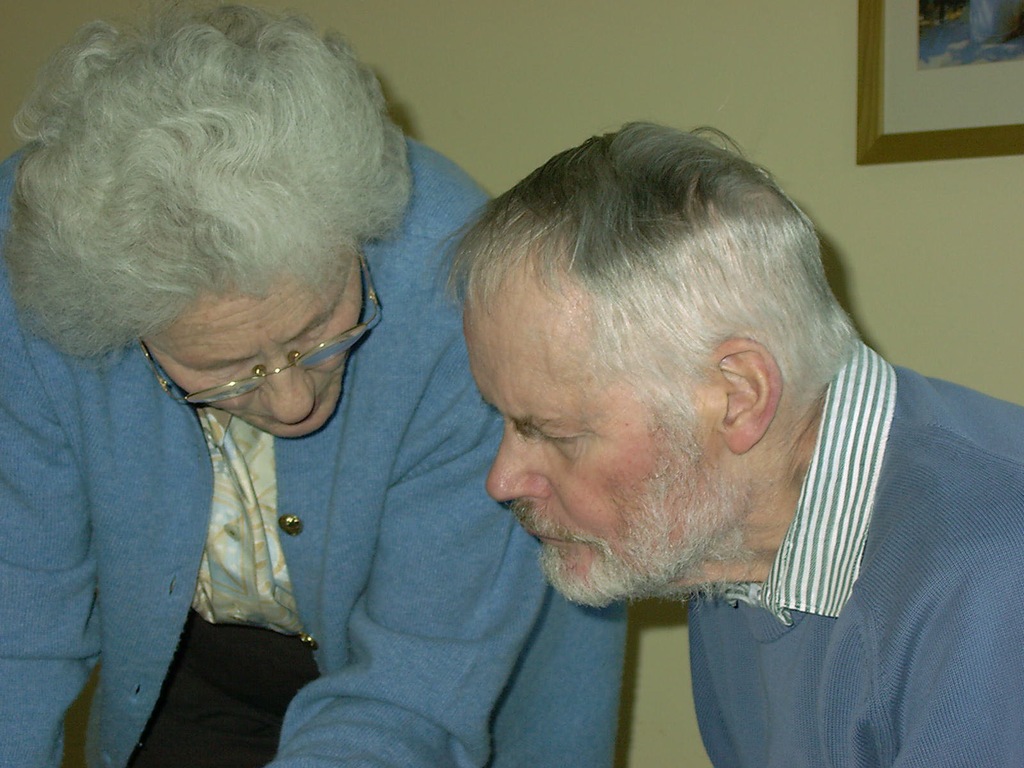
Meg visiting Keith at the care home, just a few weeks before his death.
A frequent response to my husband’s move to residential care was ‘you must be so relieved that he is being well cared for’. I am hugely relieved that there was a vacancy, as I could not have managed caring on my own for much longer. But relief is only part of it.
It is a profound and heart-rending change; the most difficult decision I have ever had to make. It was the end of our life together.
On the sidelines
Suddenly there is no privacy. We are lucky that he has a single room, but the staff have to come in and out with laundry, tablets, cups of tea. Their sudden arrival can feel like an intrusion. That room is our home now. No longer our ‘castle’.
My husband has lost all the comforting, familiar things that we have shared for so long. The things I like to be busy with are elsewhere. There are innumerable changes that seem to rob me of my wifehood.
My husband is in strangers’ hands. They are making decisions on his behalf and I am on the sidelines.
He has difficulty in communicating and I see him being misunderstood. His gentle politeness can give the impression that all is well. The carers in the home can’t know - they have not been with him for 48 years, as I have.
Losing closeness
Very little is said about sex and residential care. Photographs in brochures show smiling elderly people holding hands, the wooden arms of their chairs between them.
Partners who have shared their bed for over half their lifetime may or may not have been ‘having sex’ but may still crave the comfort of closeness, the feeling of their skin against their partner’s. A ‘Do Not Disturb’ notice is as difficult to use as it would be to hang a notice on the gate at home, telling all passers-by that they and their partner are having a special time together.
We have lost the possibility of a natural, comforting closeness.
It is certainly easier, though not always better, to be a carer with no emotional involvement. But this truism can spill over into another dimension, that of avoiding the expression of emotions at all costs. A passive patient sitting quietly is not necessarily a contented one; they may be just enduring. They are vulnerable and dependent. There can be fear behind their compliance.
It is tempting to dismiss patients’ bizarre utterances as meaningless, easy to make a thoughtless, patronising response. We must surely find a way to relieve their palpable frustration as they try to communicate from their confused worlds. I dream of a time when there will be skilled and unhurried listeners for them.
A whole-person disease
Dementia with Lewy bodies is a whole-person disease. It is heartening to hear of all the work being done towards understanding it and lessening its devastating effect.
Correct diagnosis is vital for the best treatment.
Carers are a rich source of immensely valuable and otherwise unobtainable information. If this is left untapped, knowledge of the patient’s state of health will be poorer, diagnosis possibly delayed and an opportunity lost to learn of the patient’s personhood. On all counts, pooling our knowledge makes good sense. It is the least we can do for those living with this horrible illness.
Meg’s husband, Keith, sadly died in 2003, aged 73.
Dementia Support Line
This blog post was originally published in 2018 in three parts. In 2021, it was combined into one post.
Meg's experience was taken from a chapter, written by Meg, for the 2005 book ‘Dementia with Lewy Bodies: and Parkinson's Disease Dementia’ edited by John O’Brien, David Ames, Ian McKeith and Edmond Chiu. It is reproduced here with the kind permission of Meg and the publisher, Taylor & Francis.
Read Meg’s book chapter in full within our online community, Talking Point.