

 Dementia Support Line
Real stories
‘I use my skills to give a voice to others’ – finding confidence after a dementia diagnosis
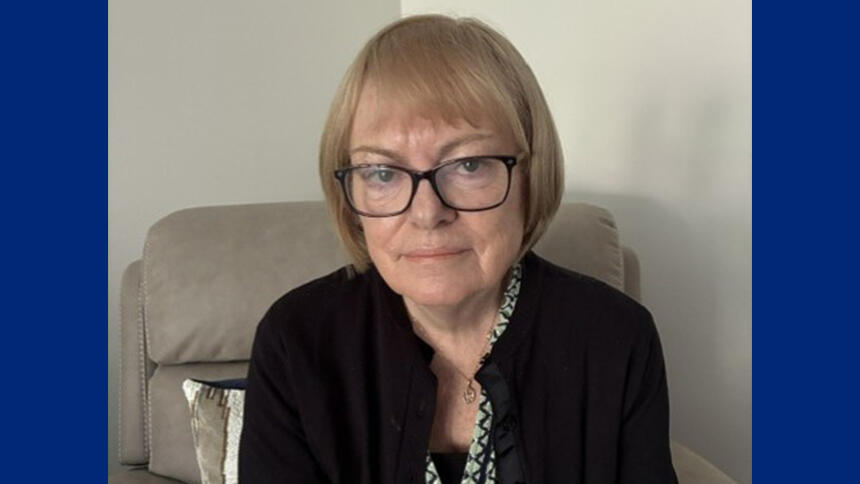
Karen Barber, in Essex, shares her thoughts about life before her dementia symptoms, before diagnosis and since.
Karen’s life was turned upside down after she started to experience early dementia symptoms in her 50s. But it took years for her to get a formal dementia diagnosis.
She’s slowly rebuilding her confidence and now uses her platform to speak out and help other people, including setting up a support group.
Before Karen developed dementia symptoms
Before the fog of dementia set in, I had lots of ‘get-up-and-go’ and I was a multi-tasker.
For over a decade, I was a senior civil servant, eventually becoming the office manager for a chief executive. I managed a team of four and oversaw high-pressure, complex workloads in HM Passport Office and Revenue and Customs.
Outside of work, I liked travelling and I was a regular at the gym. Life was busy and I loved it.
Before Karen’s dementia diagnosis
In my 50s, the skills that came naturally to me, such as organising, coordinating, remembering, began to slip away. I made mistakes I shouldn’t have made.
My GPs were dismissive, putting my symptoms down to menopause, stress, and anxiety.
Because I lacked a diagnosis, I was dismissed from work for poor performance, despite an exemplary record of appraisals and promotions.
I lost my salary and a subsequent tribunal case. I was denied medical retirement and forced to fight for six years to receive a pension that was ultimately not backdated.
It took ten years of fighting and private testing to finally hear the words: ‘you have young-onset dementia and Parkinson’s’. I was 56.
Since Karen’s dementia diagnosis
I need complex medical support and I am fed through a tube in my stomach for all nutrition and medication.
I’ve found navigating the rigid social care system really challenging.
I recently underwent a six-hour care assessment that felt utterly unfit for purpose.
There’s a damaging myth that if you can walk, you don’t need 24-hour care. This ignores the cognitive effects of dementia and the specialised needs of younger people.
Systems tend to be designed for older people, leaving those of us in middle age in a terrifying vacuum of support. As the numbers of people with young-onset dementia rise, there’s a brewing crisis that cannot be ignored.
Despite everything that’s happened, I still have fight.
I am determined to change things for other people and to raise awareness.
I would not be where I am today without my peer support group.
Their encouragement gave me the confidence to step out of the shadows and reclaim my skills. Earlier in 2026, I founded the Young Minds Dementia Group in Clacton-on-Sea.
I channel my years of civil service experience into this group. I use my networking and organising skills to provide activities, information and give a voice to those who have been forgotten.
I am ambitious – I want to see these groups across all of Essex. I have even taken my fight to Parliament, where I spoke about our broken social care system.
I speak out, not just for myself, but for every person without a voice. It’s not acceptable that we receive inadequate care.
Dementia has taken much, but it hasn’t taken my spirit.
I’m currently learning to play the piano and am about to take my grade 1 exam. It just shows that even with a dementia diagnosis, you can still learn, still achieve and still contribute.
Share your experiences
Do you want to share your experiences of life before and after your dementia diagnosis? Email the Dementia together magazine to find out more.