Six reasons why you should become a Dementia Friend

Find out why you should become a Dementia Friend to make a difference in the lives of people affected by dementia.

Dementia Friends is not a befriending initiative but is a movement to help people gain a better understanding of dementia. After becoming a Dementia Friend, you'll be able to use this knowledge to help people living with dementia feel more accepted and less socially isolated.

One in three people born in the UK today will go on to develop dementia in their lifetime. Whether you attend a friendly and interactive in-person or virtual session, you’ll be helping build a community where everyone with dementia feels understood and valued. There's also the option to watch a video.

Anyone can become a Dementia Friend and help challenge perceptions about dementia.

Our top six reasons for becoming a Dementia Friend

1. Learn about dementia and how it affects a person’s life

What is it actually like to live with dementia? How does it affect someone’s life day-to-day? When you become a Dementia Friend, you’ll learn about the real-life impact of the condition and the small actions we can all take to help those living with it.

2. Become more confident when spending time with someone with dementia

Once you’re equipped with understanding, what you do as a Dementia Friend doesn’t have to be time consuming. Simple things like showing patience and understanding can mean the world. Visiting someone you know living with the condition or someone who’s caring for a loved one can too.

I was inspired to become a Dementia Friend as I was eager to learn more about the person with dementia, how they see the world, how the disease affects them and more importantly how I could be a better person by being a friend to someone with dementia. 

I wanted to be the best I could be for anyone affected by dementia, whether that person was my mother or not.

– Katrina, Dementia Friend

3. Help people affected by dementia to stay active 

Many people with dementia experience a loss of self-confidence and become less active in their community.

You can help change this by learning about dementia and understanding what actions can help people to stay an active part of their community. That way, people with dementia can continue to take part and do the things they like, such as visiting a museum, going shopping or travelling on public transport.

4. Reduce the stigma around dementia

We shouldn’t be afraid to talk about dementia - and people affected by the condition shouldn’t be ashamed to tell others about their experience.
By becoming a Dementia Friend, you’ll help open up the conversation around dementia and inspire others to talk more about their experiences.
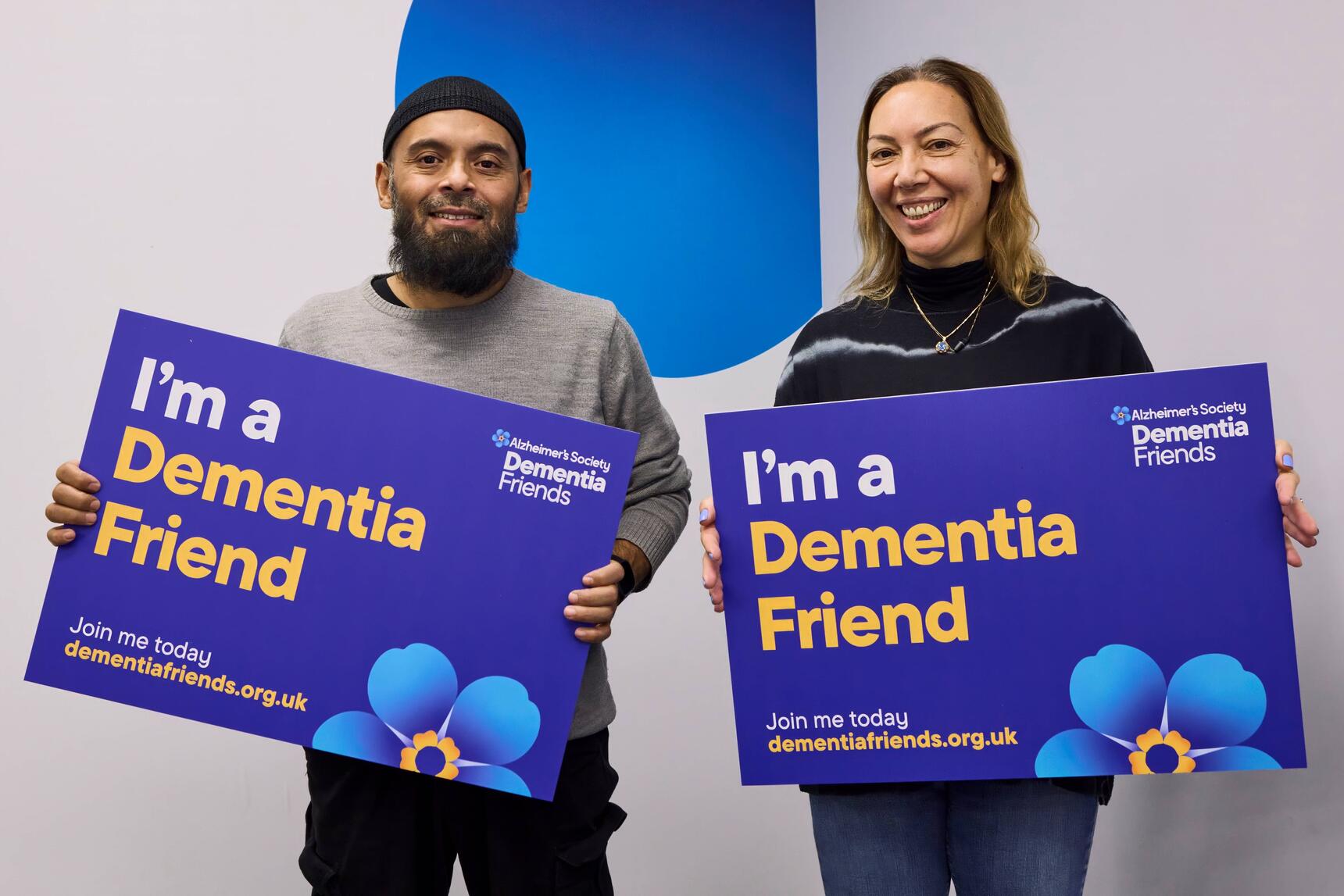
A man and woman holding blue signs that say I'm a Dementia Friend

5. Challenge misconceptions of the disease

Dementia isn’t a natural part of ageing - it affects more than someone’s memory and there is much more to a person than their dementia.
You can learn about and challenge the myths that surround dementia by becoming a Dementia Friend.

6. You’ll be joining over 3.8 million people who have already become Dementia Friends!

Dementia Friends can also show their support in other ways, by taking part in fundraising, volunteering and campaigning for Alzheimer’s Society or wearing their Dementia Friends badge to raise awareness.

It's easy to become a Dementia Friend. Our volunteer Dementia Friends Ambassadors run face-to-face and virtual Dementia Friends Sessions that you can book on to attend. Or you can watch our short online video to join. 

We believe it will take a society to beat dementia. You can play your part by becoming a Dementia Friend today.

Be a part of the Dementia Friends movement

Becoming a Dementia Friend is simple. You can either watch our short video or attend a Dementia Friends Session.

Watch our video Book onto a session

14 comments

I am a dementia Friend Champion in South Africa. I visit a dementia residential center in Johannesburg once a week. Most of the residents are in the later stages of dementia. A simple action of rubbing in hand cream will give most of them stimulation. If I can get a person to open their eyes or someone who is staring at the ground to lift their eyes, that is a success.

I have seen the carer die before the person with dementia because of the stress. Each of those carers are the quiet heroes of society but they need respite. Go and support them. There is a time where the carer and the person living with dementia will be better off when the decision is taken to move them into a dementia facility

Think of our brains as Xmas trees with candles. When we have a conversation, we exchange those candles. When a person gets dementia some of those candles go out and, depending on the level of dementia, they are not able give their candle back to you. Keep giving your candles to light up candles in their brains

I work with some lovely people with dementia and looking for ideas what i can do for activities i can plan for them hope you can help me and im based near Sudbury kind regards and Happy Christmas to you all xx

In our family even my ancestors we have no Dementia . Because we are exposed a lots of work in the farm. I saw it only in my mother in law because she got stroke and she got accident of her head. She fell down on the floor and bumped her head and their was a blood clotted in her head but the doctor gave only medicine to cure . Because she was 80 yrs old at that time so the doctor adviiced not to undergo operation because of her age.

Mixed vascular dementia—taking Aricept and Namendia—what to expect through progression?

Hi Leo,

It's important to remember that everyone experiences dementia differently. Viewing dementia as a series of stages can be a useful way to understand the condition, but how quickly it progresses depends on the individual.

We have some information on how dementia progresses on our website that you might find useful: https://www.alzheimers.org.uk/info/20073/how_dementia_progresses

You can also call our helpline for support or advice on 0300 222 11 22. It's open Monday to Friday from 9am to 5pm, extending to 8pm on Monday, Tuesday and Wednesday; Saturday to Sunday from 10am-4pm

Hope this is useful, and please let us know if you have any more questions.

Thanks,

Kyle

I became a dementia friend when my Dad was diagnosed with mixed dementia, I wanted to learn about what my Dad would be going through. I also went on and completed a Dementia Care Course through my local college to further my learning of this illness.

I agree with Caro who says : " I wish I had known about Dementia Friends", when I took care of my mother who was diagnosed as well with Dementia. I had no family nearby or friends who I could trust to help me out.
Sincerely,
Don

I cared for my mum through her diagnosis until her death. I wish I’d known about Dementia Friends at that time. Apart from practical help from social services (especially her social worker who understood the disease) I felt quite alone.
Even close members of our family became distant towards the end as they didn’t know how to cope.
It can feel very lonely and sad to watch a loved one slowly drift away from you.

I'm an Alzeimer's (dementia) friend by default as I care for a partner with advancing |Alzeimer's - it can be quite hard work, although not all the time (thankfully!!)

Jeremy

We should always be a dementia friend and extend support and compassion whether they live in their own house or in a nursing/care home.

How can you be a friend when you exclude them from activities?

Best to be a friend even when they are in advanced stage and increasingly frail and please do not invent excuses for inexplicable decisions!

Jack

I very much agree, especially with your last paragraph. I care for my Dad who lives with me, and has Alzheimers. I will do almost anything to keep him living at home with me, because I believe that in a family surrounding My Dad has a better chance of being stimulated and included in day to day routines. Just because a person is advanced (my Dad is middle to end medium stage) does not mean that they may not take things on board. There is a stigma surrounding that is it not worth visiting a person with advanced dementia. Of course, there is, even just one word may spark the brain to acknowledge a memory etc. Becoming a Dementia Friend is our chance to educate people

I signed up following the death of my Wife Pauline in 2016. She had Alzheimer's Disease for several years & I needed help at our Home to provide effective Care, & look after my own health . Eventually NHS agreed we were eligible for Continuing Healthcare but this process took nearly a year to achieve !

As it was so difficult to get help from NHS I launched a website to help as many people as possible to obtain their right to help from this source. Alzheimer's Disease does qualify provided the overall level of Need is sufficient.

However you have to be aware how NHS Assess people before the meeting takes place , so you have to be ready to answer their questions. If you are close to a relative with Alzheimer's , or a Dementia Friend , this NHS benefit enabling long term Care to be effectively funded could be the most valuable help possible for all concerned !
Details are on https://continuinghealthcare.wordpress.com/
Best wishes to all Dementia Friends . Peter Garside

I have Alzheimers so how can I be friend.

Hi Lance, thanks for your comment. Great to hear that you’re interested in becoming a Dementia Friend! There are two ways to join:

The first is to attend a face-to-face Information Session in your area. You can search for one in your area here: https://www.dementiafriends.org.uk/WEBSession

Alternatively, you can watch the video on our website and register to become a Dementia Friend, here: https://www.dementiafriends.org.uk/

Also, Alzheimer’s Society can provide lots of help and support if you are looking for it. Find out more on our website and let us know if you have any more questions.