

 Dementia Support Line
Research
Could boosting the brain’s natural cleaning processes affect the development of dementia?
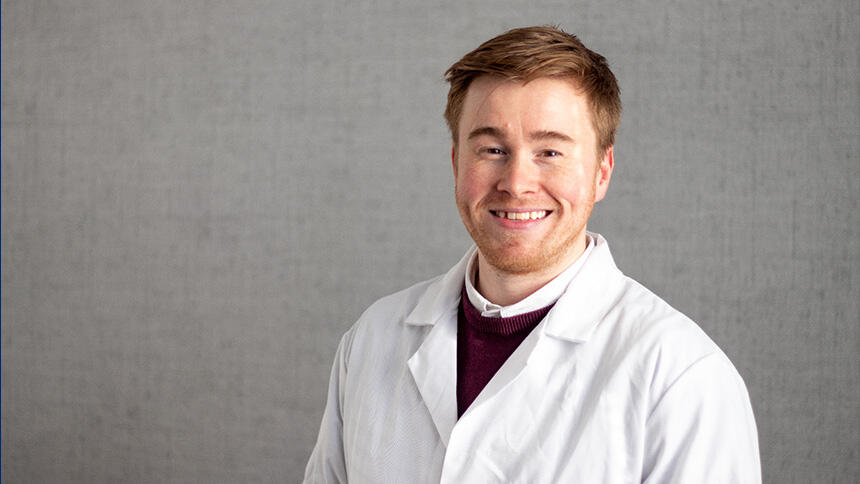
Ian Harrison is researching how the brain gets rid of waste in the hope that strengthening these processes could help slow or prevent memory loss.
Ian Harrison has a long-held drive to fight dementia after seeing its devasting effects first-hand.
‘When I was a teenager, two of my grandparents were diagnosed with dementia. My paternal grandfather had Alzheimer’s disease and my maternal grandmother had dementia with Lewy bodies,’ says Ian, now at UCL (University College London).
‘I remember my parents telling me that there were no medicines that would make them better, and that they were just going to get more poorly with time.
This seemed so baffling to me at the time, as so many medical conditions are treatable, but why not dementia?
Impact for people with brain diseases
At university, Ian studied pharmacology to understand more about how drugs work. He then went on to specialise in brain diseases.
‘My aim being to make a difference to those living with these diseases and their loved ones.’
Fast forward to now, Ian recently became Alzheimer’s Society’s third ever Carol Jennings Fellow. This fellowship was created in memory of our former Vice-President’s passionate campaign work.
Ian’s current focus is studying the brain’s natural cleaning system, called the glymphatic system.
During sleep, the glymphatic system works to flush out waste from the brain. This waste includes amyloid, a protein that builds up in the brains of people with Alzheimer’s. However, as we age, this cleaning system becomes less effective.

A potential drug to boost the brain’s cleaning
Ian wants to see if there’s a way of targeting the glymphatic system to help it reduce the build-up of harmful proteins.
With his team, he’s looking at a new drug, called TGN-073, and its potential to boost the cleaning process and help slow or prevent memory loss.
If successful, Ian says it could change the way dementia is treated and managed. It could also unlock new approaches to treating other diseases.
‘If we’re able to show that this concept has potential, it opens up the possibility of its targeting in other neurodegenerative diseases in which proteins build up in the brain, such as Parkinson’s disease and Huntington’s disease.’
Advances in dementia treatment
Ian feels incredibly optimistic about his work and about wider developments in dementia research.
‘This is a very exciting field to be in, and I can’t wait to see what the coming years will bring.
We have seen huge advances in dementia treatment in recent years, and that is all down to early investment in bold and innovative research ideas.
He describes the support and funding he receives from the Society as ‘empowering’.
‘I’m deeply aware that behind every pound donated is a person or family affected by dementia.
‘It’s that personal connection that fuels my commitment to pushing this research forward. We are all working toward the same goal: a world without the heartbreak of dementia.’
‘I’m just so grateful to Alzheimer’s Society for putting its faith in me.’
Your donation funds research
Your donation helps us to fund research into all forms of dementia, from prevention to breakthrough drug treatments.