

 Dementia Support Line
Research
Using smart tech and AI to help people with dementia live independently
Magdalena Kolanko researches at-home devices that collect and analyse data and could help people with dementia to live independently for longer.
Magdalena Kolanko says her passion to help people affected by dementia was kickstarted early on in her career as a doctor.
A neurologist and Alzheimer's Society-funded clinical research fellow, Magdalena is keen to develop new ways to provide care and support.
‘I experienced first-hand the devastating effects of dementia on patients and their families, as well as appreciating the huge scale of the problem,’ she says.
‘I was also struck by the limited effectiveness of current therapeutic options.’
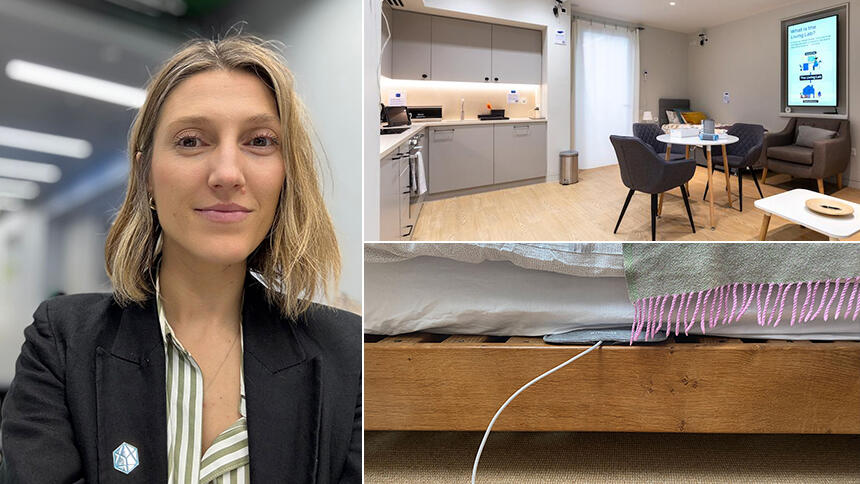
Magdalena Kolanko and UK Dementia Research Institute’s ‘Living Lab’
Researching dementia technology
Magdalena splits her time between working in the NHS and completing her PhD at Imperial College London.
She researches how digital technology could improve people’s lives at the pioneering Centre for Care Research & Technology, part of the UK Dementia Research Institute (DRI).
Magdalena is looking at how devices can analyse and predict a person’s behaviour, to help make sure they’re getting the right support.
‘We use devices such as sleep mats or wall-mounted activity sensors to collect data about people’s behaviours then analyse it using artificial intelligence (AI) models to make predictions about what they might do,’ she explains.
As well as collecting this data in people’s own homes, the UK DRI has a ‘living lab’, which is basically a small model flat.
‘It’s fitted with a whole range of sensors and digital technologies and here we can test people performing real-life tasks such as making a cup of tea or preparing toast.’

Monitoring infections in people with dementia
The aim of collecting and analysing data about a person’s behaviour is to pick up any early signs that they need more support.
This could help people to stay independent for longer, as well as reducing unnecessary hospital visits and stays.
‘For example,’ says Magdalena, ‘we have developed an easy and reliable way of measuring night time heart rate, breathing and behaviour, using a small under-mattress sensor.’
Given the information from this device, an AI model has learned to identify signs that a person is developing an infection.
I showed that our model can reliably detect early signs of Covid and other respiratory infections
‘And it often flags up any serious deterioration in health, so people can be assessed and receive early treatment.’
This system is already being offered to people with dementia in west London so they can be monitored at home.
Working with healthcare professionals
Research is most productive when people work together, and Magdalena’s study touches on all kinds of areas.
She collaborates with a varied team of healthcare professionals, including occupational therapists, physiotherapists, dementia nurses and sleep specialists.
But she also works with experts from wider ranging fields, such as engineers and computer scientists.
This means we can translate our research – even the most technical aspects of it – into real-life interventions.
That keeps a focus on what people with dementia would actually find most useful in everyday life.
‘I particularly enjoy working with our designers, who help us to make our software and devices dementia friendly.’
Transforming dementia care
Balancing her busy work and home lives can be challenging, says Magdalena. However, seeing the positive impact of her work on people’s lives keeps her motivated.
She is also buoyed by the support she receives from Alzheimer’s Society.
‘The training fellowship I was awarded has not only funded my PhD research, but also allowed me to expand my work with digital health technology into new areas of dementia care.’
Overall, Magdalena feels upbeat about how technology could transform care for people with dementia.
There’s particular potential in linking information from devices in people’s homes with wider health services.
‘In addition to enabling people to continue to live safely in their own homes, this will improve quality of life and potentially save money.
‘With most people wishing to remain at home, I hope these new technologies and innovations will help keep people safe and independent for longer.’
Your donation funds research
Your donation helps us to fund research into all forms of dementia, from prevention to breakthrough drug treatments.